Africa’s business ecosystem holds immense potential but still faces capital gaps. Bridging this through diaspora investment can accelerate growth while providing compelling social impact opportunities.
The African startup and small business (SME) ecosystem holds immense growth potential but still faces challenges in accessing the patient capital needed to thrive.
With a young, tech-savvy population, rapidly growing middle class, and abundance of social and environmental challenges to solve – the opportunities for impact and returns are plentiful. However, critical funding gaps persist.
Bridging the Diaspora Capital Gap
With over $100 billion in remittances sent annually from the widespread African diaspora back to the continent, there is vast potential to channel these funds into promising early-stage ventures.
However, issues like lack of awareness, trust, negative perceptions, and quality deal access have hampered this.
Venture funding in Africa remains heavily skewed towards later stages, while early-stage startups struggle to raise pre-seed and seed funding to refine products and gain initial traction.
An in-session snapshot of our webinar this week. Catch the full conversation on YouTube.
As discussed by expert panelists Jennifer Frimpong of Ma Adjaho & Co and ARED CEO Henri Nyakarundi during Part 1 of our Diaspora investment-focused webinar series, cultural familiarity bias also plays a role.
Diaspora investors often gravitate towards opportunities in their countries of origin due to personal ties and familiarity. But this limits the scope of potential investments.
Building trust and awareness for platforms like Daba that conduct rigorous due diligence and open access to thoroughly vetted, transparent deals across Africa is critical to overcoming this bias.
Empowering Startups and Investors in Africa
Frimpong explained that Startups need more support “professionalizing” to “investment readiness” to attract diaspora capital.
From sharpening their value propositions to refining financial modeling and crafting compelling pitches – startups need hands-on nurturing.
With the right acceleration of high-potential ventures, sectors from agribusiness to fintech, e-commerce, and beyond can offer diasporans compelling opportunities with social impact.
Seizing Africa’s Growth Momentum
Africa’s startup scene is set to thrive over the next decade, especially with the power of the diaspora and platforms like Daba expanding early-stage funding access.
But realizing this immense potential requires collective action across public, private, and non-profit spheres to foster entrepreneurial talent and inject growth capital into the ecosystem.
We encourage all those looking to support African enterprises – whether through investment, policy reform, incubation, or other means – to learn more and get involved and in touch.
The time is now to funnel diaspora capital into the continent’s brightest ventures. With coordinated efforts, Africa’s startup ecosystem can transform economies and uplift millions.
If you could not join the webinar or would like to watch it again, you can catch the recording on our YouTube channel. And to find more about how Daba enables investing in Africa opportunities for individual and institutional investors, visit our webpage or get our mobile app.
Ces dernières présentent de forts effets multiplicateurs en vue de réduire la pauvreté et de favoriser la prospérité partagée sur le continent.
L’alimentation et les boissons, l’infrastructure, les soins de santé, l’éducation et les énergies renouvelables sont apparus comme les cinq principaux secteurs pour les opportunités d’investissement dans le rapport.
Ensemble, ils représentent plus de 60 % des opportunités identifiées couvrant l’Afrique de l’Est, de l’Ouest et australe.
L’équipe d’intelligence de Daba explore en outre cinq autres secteurs. Lisez la suite pour découvrir où se trouvent les opportunités d’investissement les plus attractives en Afrique.
Où investir en Afrique : Voici les 10 secteurs les plus prometteurs
1. Alimentation et Agriculture
Le secteur de l’alimentation et de l’agriculture joue un rôle économique intégral à travers l’Afrique.
Malgré la croissance de sa classe moyenne et une réduction de sa dépendance à l’agriculture, l’Afrique continue de connaître une population croissante et une demande croissante en matière d’alimentation.
Par conséquent, le continent offre des perspectives d’investissement substantielles dans les secteurs de l’agriculture et de l’agroalimentaire. Ces opportunités englobent des investissements dans divers aspects de la chaîne de valeur agricole, notamment les terres agricoles, les intrants agricoles, la transformation et les innovations agritech.
L’Afrique subsaharienne, en particulier, est confrontée à des besoins agricoles importants qui vont au-delà des éléments fondamentaux tels que les engrais, les semences et l’irrigation pour inclure des améliorations essentielles de l’infrastructure.
Les entreprises impliquées dans l’amélioration des routes, des installations de stockage, des ports et des réseaux électriques dans la région peuvent également prospérer en soutenant et facilitant la croissance des opérations agricoles florissantes de l’Afrique subsaharienne.
Ces investissements offrent non seulement des rendements financiers potentiels, mais contribuent également à relever les défis de sécurité alimentaire auxquels la région est confrontée.
L’Afrique continue de connaître une population croissante et une demande croissante en alimentation.
2. Infrastructure
Les besoins en infrastructure restent critiques pour faire avancer les résultats socio-économiques. Les exigences continuent de croître au milieu de l’urbanisation rapide et de l’industrialisation.
Bien que la pénurie d’infrastructures en Afrique soit indéniable, elle offre de nombreuses opportunités d’investissement, notamment pour des secteurs tels que la construction, les télécommunications, l’énergie et les transports, entre autres.
La BAD estime que le continent aura besoin jusqu’à 170 milliards de dollars par an d’ici 2025 pour rénover ses infrastructures, les deux tiers de ce montant étant nécessaires pour des infrastructures entièrement nouvelles et le tiers restant pour la maintenance.
Par conséquent, les routes, le logement, l’électricité, la gestion des déchets et d’autres projets à long terme signalent un fort potentiel de partenariat public-privé.
3. Soins de Santé
Les secteurs des soins de santé et des médicaments sur ordonnance sont estimés à une valeur combinée de 3 milliards de dollars, les médicaments innovants/brevetés contribuant approximativement à hauteur de 1,7 milliard de dollars à cette valeur. Les médicaments en vente libre détiennent actuellement une valeur de 378 millions de dollars.
Étant donné la montée en puissance des sociétés pharmaceutiques produisant des médicaments génériques, il est fort probable qu’il y ait une augmentation des investissements dans le secteur de la santé du pays.
Cela est particulièrement significatif compte tenu du fait que 85 % de la population africaine dépend des services de santé publics.
Il est raisonnable de prévoir que le public accueillerait favorablement le Plan national d’assurance maladie, cherchant ainsi à accéder à des médicaments et à des installations de traitement plus abordables.
Ne manquez pas les opportunités d’investissement exclusives en Afrique ! Téléchargez l’application Daba dès aujourd’hui et débloquez un monde de rendements potentiels tout en ayant un impact positif.
4. Éducation
Investir dans l’éducation en Afrique représente une opportunité de soutenir la croissance du continent tout en générant des rendements.
La population africaine devrait doubler d’ici 2050, ce qui entraînera une demande croissante en matière d’éducation de qualité.
Des opportunités d’investissement existent dans la construction et la gestion d’écoles, la technologie éducative, les bourses d’études et les programmes de formation.
Les écoles privées et l’enseignement supérieur sont particulièrement prometteurs compte tenu de la demande croissante en éducation de qualité et abordable.
La technologie éducative offre également une opportunité à grande échelle. Avec l’augmentation de l’accès aux mobiles et à Internet, les plateformes en ligne et les applications peuvent fournir une éducation abordable dans des régions éloignées et mal desservies.
Investir dans l’éducation en Afrique offre une opportunité de soutenir la croissance du continent tout en générant des rendements.
Fournir des bourses d’études et des formations aux étudiants et aux professionnels africains est un autre investissement important. Les partenariats avec des organisations déjà actives dans cet espace offrent des canaux d’investissement idéaux.
L’expansion de la population jeune de l’Afrique et la demande d’éducation de qualité créent une opportunité de stimuler le développement grâce à l’investissement et de générer des rendements financiers.
5. Énergies Renouvelables
L’Afrique dispose de ressources énergétiques renouvelables abondantes qui présentent d’importantes opportunités d’investissement alors que le continent passe aux sources d’énergie durables.
L’énergie solaire et éolienne devrait connaître une croissance massive, avec une capacité installée augmentant de 100 fois pour le solaire et de 35 fois pour l’éolien d’ici 2050. Cela nécessitera des milliards d’investissements au cours des prochaines décennies.
Le Maroc, l’Afrique du Sud et les pays d’Afrique du Nord seront des marchés clés pour les projets solaires et éoliens en raison de l’irradiation solaire forte et des ressources éoliennes, selon le Forum économique mondial.
L’énergie hydroélectrique offre également un potentiel substantiel, avec une capacité attendue quadruplée d’ici 2050. Les pays d’Afrique subsaharienne disposent des plus grandes ressources hydroélectriques restantes à exploiter. La production d’hydrogène vert est un autre domaine prêt pour une croissance et des exportations majeures, avec des projets déjà en cours au Maroc, en Namibie et en Afrique du Sud.
Cumulativement, près de 3 000 milliards de dollars de dépenses en capital sur les énergies renouvelables et les infrastructures de soutien seront nécessaires en Afrique d’ici 2050. Investir tôt permet aux institutions financières de conduire la transition et de capitaliser sur les opportunités à long terme.
Le paysage des technologies propres en Afrique connaît un essor sans précédent, alimenté par une combinaison de ressources renouvelables abondantes.
6. Marchés des matières premières
De nombreux pays africains dépendent largement du commerce des matières premières. Certains d’entre eux naviguent à travers les cycles des matières premières, comme le montrent les principaux pays exportateurs de pétrole comme l’Angola et le Nigeria, ainsi que les pays producteurs de cuivre tels que la République démocratique du Congo et la Zambie.
Selon les estimations de l’ONU, l’Afrique détient plus de 30 % des réserves minérales mondiales, y compris plus de la moitié des réserves mondiales d’or, de chrome et de platine, une proportion importante des réserves mondiales de diamants, et 5 % des réserves naturelles de minerai de lithium.
Le continent abrite également les principaux exportateurs mondiaux de produits agricoles tels que le cacao (Côte d’Ivoire et Ghana), le café (Éthiopie et Ouganda), le thé (Kenya) et le coton (Bénin, Burkina Faso, Égypte, Soudan et Mali).
Vous recherchez une chance de faire une différence tout en obtenant des rendements. Rendez-vous sur notre application pour commencer à investir dans la croissance de l’Afrique dès aujourd’hui !
7. Commerce de détail et commerce électronique
L’expansion de la classe moyenne africaine, qui est passée de 313 millions de personnes au cours des 30 dernières années, présente des perspectives d’investissement attrayantes dans des secteurs axés sur le commerce de détail.
Pour donner un contexte, les entreprises de télécommunications en Afrique ont ajouté plus de 400 millions d’abonnés, soit plus que l’ensemble de la population américaine, depuis 2000.
La croissance de la classe moyenne africaine peut être attribuée principalement à une expansion économique robuste, à un passage vers l’emploi salarié et à un éloignement de l’agriculture. Le rythme général peut avoir été plus lent que prévu, mais la composition démographique du continent reste attrayante.
Pour répondre à ce marché, une industrie du commerce électronique en pleine croissance émerge rapidement, aidée par un nombre croissant d’utilisateurs d’Internet. D’ici 2025, l’Afrique devrait avoir plus d’un demi-milliard d’acheteurs en ligne, avec une pénétration de 40 % et un taux de croissance annuel composé de 17 %.
8. Immobilier et logement
L’urbanisation et la croissance démographique dans de nombreux pays africains ont alimenté une demande croissante en matière de logements résidentiels et commerciaux.
Ce paysage dynamique offre des opportunités attrayantes dans les projets de développement immobilier, permettant aux investisseurs de capitaliser sur l’élan de croissance du continent pour potentiellement tirer profit de la valorisation des biens immobiliers.
De nombreuses techniques d’investissement éprouvées qui ont réussi dans le monde occidental, telles que les locations à long terme, les fiducies de placement immobilier (FPI), les locations de vacances et les options de bail, peuvent générer des rendements comparables sur le marché africain.
Les investisseurs qui préfèrent une approche prudente peuvent envisager des options telles que les FPI et autres fonds immobiliers. Ces véhicules d’investissement peuvent offrir une exposition au marché immobilier tout en diversifiant les risques et en offrant potentiellement des rendements plus stables.
9. Services Financiers et Fintech
Le paysage des services financiers en Afrique a évolué au cours des deux dernières décennies et jouera un rôle crucial dans la sécurisation de l’avenir du continent.
Sans financement durable et crédit commercial, le développement de projets dans des domaines clés tels que l’infrastructure, les soins de santé et les projets énergétiques reste conceptuel plutôt que réalité.
Les réformes réglementaires, l’émergence d’une classe moyenne urbaine et les avancées technologiques permettent aux institutions financières d’accéder à des mécanismes de financement pour atténuer les risques et maximiser les rendements.
Les revenus dans le secteur des services financiers dans son ensemble pourraient croître à environ 10 % par an pour atteindre 230 milliards de dollars d’ici 2025.
L’émergence de solutions basées sur la technologie financière détient particulièrement une grande promesse pour ce secteur. Le potentiel fintech de l’Afrique était d’environ 150 milliards de dollars en 2020, selon un rapport de McKinsey, alimenté par l’assurance, le commerce de détail et les prêts aux PME.
À l’avenir, le marché devrait croître de 10 % par an pour atteindre environ 230 milliards de dollars d’ici 2025, avec le secteur de la blockchain, des paiements et des portefeuilles prévu pour croître le plus rapidement.
Vous voulez franchir la prochaine étape pour exploiter le potentiel d’investissement de l’Afrique ? Rendez-vous sur notre site Web ou téléchargez dès maintenant l’application Daba pour commencer votre voyage.
10. Technologie et Innovation
Le secteur technologique de l’Afrique connaît une croissance rapide, avec de nombreuses entreprises innovantes émergentes pour relever les défis du monde réel et répondre aux demandes des consommateurs.
Ces startups africaines bénéficient de plusieurs avantages, notamment le fait d’être les premiers à se lancer sur le marché et de s’aligner sur des tendances démographiques favorables.
Malgré le ralentissement économique mondial de 2022, les startups africaines ont réussi à obtenir des niveaux record de financement de la part de capitaux-risqueurs aux États-Unis, en Europe et dans d’autres régions.
Notamment, le continent a même donné naissance à sept licornes – startups valorisées à plus de
1 milliard de dollars – soulignant ainsi davantage le potentiel naissant et le succès de l’industrie technologique en Afrique.
Impacts et Rendements
La plupart des opportunités sont projetées pour générer un nouvel impact positif pour les groupes sous-desservis. Cela indique qu’elles peuvent contribuer de manière significative à surmonter les défis urgents de développement durable.
Elles offrent également des rendements attractifs. Environ la moitié prévoit des taux de rendement internes dépassant 20 %, accompagnés de marges bénéficiaires brutes élevées.
Cependant, des horizons d’investissement à long terme sont courants, en particulier dans des secteurs à forte intensité de capital tels que le transport et l’infrastructure, où la patience est essentielle.
Financement et Mise en Œuvre
Bien que certaines opportunités répondent aux conditions de financement à taux de marché, la plupart nécessitent des approches publiques-privées mixtes.
Ces partenariats peuvent aborder les risques liés à la réglementation, à l’accessibilité, aux lacunes en compétences et aux contraintes de l’environnement propice.
Les collaborations à travers des organismes régionaux tels que la Zone de Libre-Échange Continentale Africaine permettent également aux entreprises d’accéder à des marchés plus vastes, de diversifier les portefeuilles et de partager des expériences. De plus, ils permettent aux pays de se concentrer sur des interventions autour de leurs avantages comparatifs.
La Voie à Suivre: Saisissez les Opportunités d’Investissement en Afrique dès Aujourd’hui
L’Afrique offre de nombreuses perspectives d’investissement pour fournir simultanément un impact positif et des gains financiers à moyen et long terme.
Les investisseurs institutionnels et les partenaires au développement doivent continuer à travailler ensemble pour transformer les opportunités en réalité dans des domaines tels que l’agriculture, l’infrastructure, les soins de santé, l’éducation et les énergies renouvelables.
Pour plus de contenu et d’analyses sur les tendances économiques et les opportunités d’investissement en Afrique, téléchargez dès aujourd’hui l’application Daba ! Et si vous êtes un investisseur institutionnel prêt à explorer des opportunités adaptées à vos intérêts et objectifs, remplissez ce formulaire d’intérêt sur le site Web de Daba !
These present strong multiplier effects towards poverty reduction and shared prosperity on the continent.
Food and beverages, infrastructure, healthcare, education, and renewable energy emerged as the top five sectors for investment opportunities in the report.
Together, they accounted for over 60% of identified prospects spanning Eastern, Western, and Southern Africa.
The Daba Intelligence team further explores five more sectors. Read on to discover where Africa’s hottest investment opportunities lie.
Where To Invest In Africa: Here Are The Top 10 Most Promising Sectors
1. Food and Agriculture
The food and agriculture sector plays an integral economic role across Africa.
Despite the growth of its middle class and a reduced reliance on agriculture, Africa continues to experience a rising population and an increasing demand for food.
As a result, the continent offers substantial investment prospects in the agriculture and agribusiness sectors. These opportunities encompass investments in various aspects of the agricultural value chain, including farmland, agricultural inputs, processing, and agritech innovations.
Sub-Saharan Africa, in particular, faces significant agricultural needs that extend beyond fundamental elements like fertilizer, seeds, and irrigation to include essential infrastructure improvements.
Companies involved in enhancing roads, storage facilities, ports, and power grids in the region can also thrive as they support and facilitate the growth of Sub-Saharan Africa’s thriving agricultural operations.
These investments not only offer potential financial returns but also contribute to addressing the food security challenges that the region faces.
Africa continues to experience a rising population and an increasing demand for food.
2. Infrastructure
Infrastructure needs remain critical for advancing socioeconomic outcomes. Requirements continue rising amidst rapid urbanization and industrialization.
While Africa’s infrastructure shortage is undeniable, it provides abundant investment opportunities – particularly for sectors like construction, telecommunications, energy, and transportation, to name a few.
The AfDB estimates that the continent needs up to $170 billion per year by 2025 to overhaul its infrastructure, with two-thirds of that being needed for entirely new infrastructure and the remaining one-third for maintenance.
Consequently, roads, housing, electricity, waste management, and other long-term projects signal strong public-private partnership potential.
3. Healthcare
The healthcare and prescription medicines sectors are estimated to have a combined worth of $3 billion, with innovator/patented medications contributing around $1.7 billion to this value. Over-the-counter medicines currently hold a value of $378 million.
Given the rise in pharmaceutical companies producing generic medicines, there’s a strong likelihood of increased investment in the nation’s healthcare sector.
This is particularly significant considering that 85% of Africa’s population depends on public health services.
It’s reasonable to anticipate that the public would readily embrace the National Health Insurance Plan, seeking access to more affordable medicines and treatment facilities.
Don’t miss out on exclusive investment opportunities in Africa! Download the Daba app today and unlock a world of potential returns while making a positive impact.
4. Education
Investing in education in Africa presents an opportunity to support the continent’s growth while yielding returns. Africa’s population is expected to double by 2050, driving demand for quality education.
Investment opportunities exist in building and running schools, educational technology, scholarships, and training programs. Private schools and higher education are particularly promising given the increasing demand for affordable, quality education.
Educational technology also provides a large-scale opportunity. With growing mobile and internet access, online platforms and apps can deliver affordable education in remote, underserved areas.
Investing in education in Africa presents an opportunity to support the continent’s growth while yielding returns.
Providing African students and professionals with scholarships and training is another impactful investment. Partnerships with organizations already active in this space provide ideal investment channels.
Africa’s expanding youth population and demand for quality education create an opportunity to spur development through investment and generate financial returns.
5. Renewable energy
Africa has abundant renewable energy resources that present major investment opportunities as the continent transitions to sustainable energy sources.
Solar and wind power are projected to see massive growth, with installed capacity increasing 100x for solar and 35x for wind by 2050. This will require billions in investment over the coming decades.
Morocco, South Africa, and North African countries will be key markets for solar and wind projects due to strong solar irradiation and wind resources, according to the World Economic Forum.
Hydroelectric power also offers substantial potential, with capacity expected to quadruple by 2050. Sub-Saharan African countries have the greatest remaining hydro resources to tap. Green hydrogen production is another area primed for major growth and exports, with projects already underway in Morocco, Namibia, and South Africa.
Cumulatively, nearly $3 trillion in capital expenditure on renewables and supporting infrastructure will be needed in Africa by 2050. Investing early can allow financial institutions to drive the transition and capitalize on long-term opportunities.
Africa’s CleanTech landscape is experiencing an unprecedented boom, fueled by a combination of abundant renewable resources.
6. Commodity markets
Many African nations rely extensively on the trade of commodities. Some of them navigate the ups and downs of commodity cycles, exemplified by major oil-exporting countries like Angola and Nigeria, as well as copper-producing nations such as the Democratic Republic of Congo and Zambia.
According to UN estimates, Africa holds over 30% of global mineral reserves, including more than half the world’s reserves of gold, chrome, and platinum, a significant proportion of global diamond reserves, and 5% of naturally occurring lithium ore reserves.
The continent is also home to leading global exporters of agricultural commodities like cocoa (Cote d’Ivoire and Ghana), coffee (Ethiopia and Uganda), tea (Kenya), and cotton (Benin, Burkina Faso, Egypt, Sudan, and Mali).
Looking for a chance to make a difference while earning returns. Head over to our app to start investing in Africa’s growth today!
7. Retail and e-commerce
Africa’s expanding middle class, which has surged from 313 million people over the past 30 years, presents enticing investment prospects in retail-focused sectors.
For context, telecom companies in Africa have added over 400 million subscribers—more than the entire US population—since 2000.
The growth of Africa’s middle class can be attributed mainly to robust economic expansion, a shift towards salaried employment, and a move away from agriculture. The general pace may have been slower than expected but the continent’s demographic makeup remains attractive.
Catering to this market is a rapidly growing e-commerce industry, helped by an increasing number of Internet users. By 2025, Africa is forecast to have over half a billion online shoppers, with a 40% penetration, and a 17% compound annual growth rate (CAGR).
8. Real estate and housing
Urbanization and population growth in numerous African countries have fueled a rising demand for both residential and commercial real estate.
This dynamic landscape offers compelling opportunities in real estate development projects, allowing investors to capitalize on the continent’s growth momentum to potentially profit from the appreciating property values.
Many of the proven investment techniques that have succeeded in the Western world, such as long-term rentals, real estate investment trusts (REITs), vacation rentals, and lease options, can yield comparable returns in the African market.
Investors who prefer a cautious approach can consider options like REITs and other real estate funds. These investment vehicles can provide exposure to the real estate market while diversifying risk and potentially offering more stable returns.
9. Financial services and fintech
Africa’s financial services landscape has evolved over the last two decades and will play a critical role in securing the continent’s future.
Without sustainable funding and commercial credit, project development in key areas such as infrastructure, healthcare, and energy projects remain concepts rather than reality.
Regulatory reforms, the emergence of an urban middle class, and technological advancements allow financial institutions access to funding mechanisms to mitigate risk and maximize returns.
Want to take the next step in tapping Africa’s investment potential? Head over to our website or download the Daba app now to start your journey.
Revenues in the financial services sector at large could grow at about 10% per annum to $230 billion by 2025.
The emergence of fintech-driven solutions particularly holds great promise for this sector. Africa’s fintech potential was around $150 billion in 2020, per a report by McKinsey, fueled by insurance, retail, and SME lending.
Going forward, the market is projected to grow by 10% per year to reach around $230 billion by 2025, with the blockchain, payments, and wallets sectors expected to grow fastest.
10. Technology and Innovation
Africa’s technology sector is experiencing rapid growth, with numerous innovative companies emerging to address real-world challenges and cater to consumer demands.
These African startups enjoy several advantages, including being early movers in the market and aligning with favorable demographic trends.
Despite the global economic slowdown experienced in 2022, African startups managed to secure record levels of funding from venture capitalists in the United States, Europe, and other regions.
Notably, the continent has even given rise to seven unicorns – startups valued at over $1 billion – further underlining the burgeoning potential and success of Africa’s tech industry.
Impact and Returns
Most opportunities are projected to generate a new positive outcome for underserved groups. This indicates they can meaningfully contribute to overcoming pressing sustainable development challenges.
They also offer attractive returns. About half forecast internal rates of return exceeding 20%, alongside high gross profit margins.
However, long investment horizons are common, especially in capital-intensive sectors like transportation and infrastructure where patience is key.
Financing and Implementation
Although some opportunities meet conditions for market-rate financing, most require blended public-private approaches.
These partnerships can address risks related to regulation, affordability, skills gaps, and enabling environment constraints.
Collaborations through regional bodies like the African Continental Free Trade Area also allow businesses to access larger markets, diversify portfolios, and share experiences. Additionally, they enable countries to focus interventions around their comparative advantages.
The Way Forward: Seize Africa’s Investment Opportunities Today
Africa provides abundant investment prospects to simultaneously deliver positive impact and financial gains over the medium to long term.
Institutional investors and development partners should continue working together to turn opportunities into reality in areas including agriculture, infrastructure, healthcare, education, and renewable energy.
And for retail investors, the good news is that the proliferation of investment platforms like Daba makes participating in investment opportunities in Africa’s emerging markets easier than ever.
For more content and analysis on economic trends and investment opportunities in Africa, get the Daba application today! And if you’re an institutional investor ready to explore opportunities tailored to your interests and objectives, fill out this interest form on the Daba website!
Despite contributing only 3.8% of global greenhouse gas emissions, Africa faces the brunt of climate change’s wrath. Emerging VC-backed innovators aim to change the continent’s fortunes.
In 2022, climate-tech funding in Africa grew 3.5x to over $860m, making climate Africa’s most funded sector after fintech.
The funding was largely driven by clean energy technologies.
Broadly, the cleantech sector attracted the most foreign direct investment (FDI) flows into Africa, per the Africa Attractiveness Report by global consulting giant EY. (You can read our summary of the report here)
The timing of this surge in climate funding couldn’t be better.
Climate change comes to Africa
The scorching heat waves, drying water sources, and erratic weather patterns are no longer distant nightmares for Africa.
Climate change is here, and its impact is undeniable.
Despite contributing only 3.8% of global greenhouse gas emissions, Africa faces the brunt of climate change’s wrath.
For comparison, China, the United States, and the European Union account for 23%, 19%, and 13% respectively.
Yet in 2019, five of the ten countries most affected were African nations, bearing the consequences of devastating weather disasters.
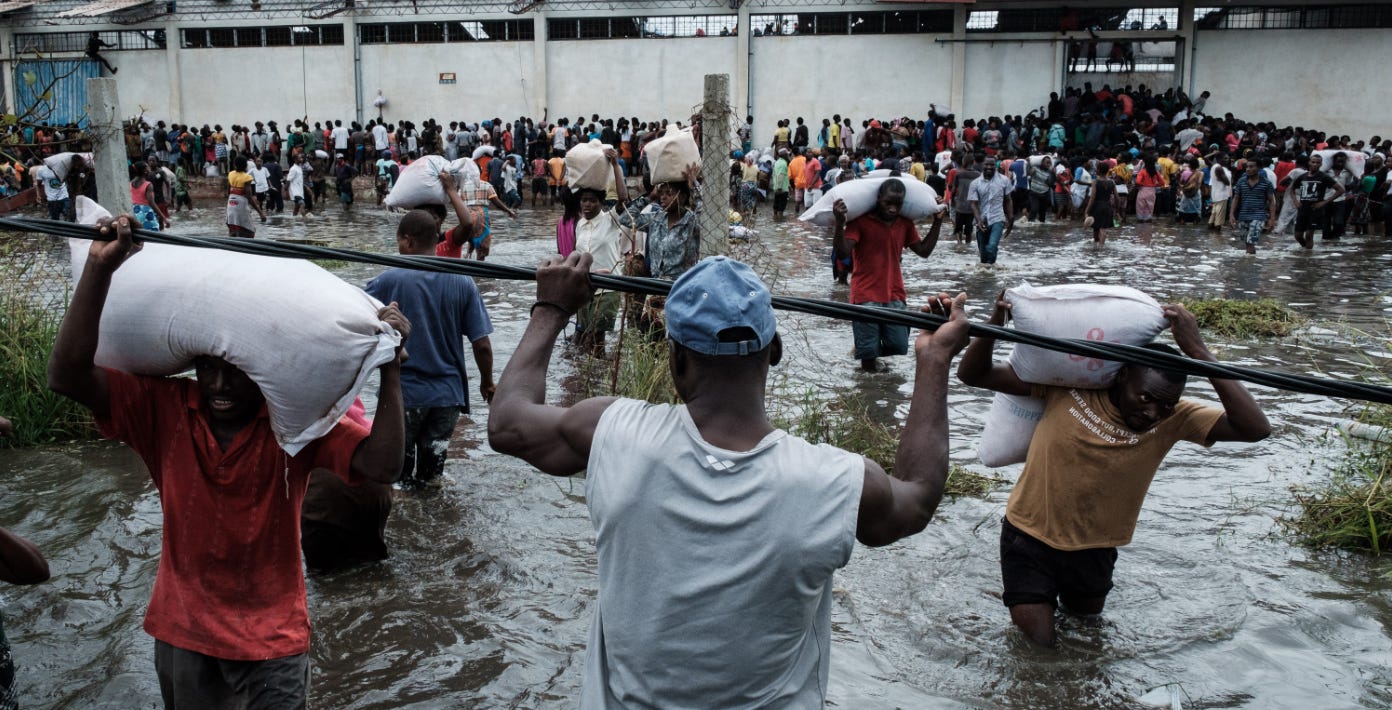
Mozambique, Zimbabwe, Malawi, South Sudan, and Niger faced devastating weather disasters like Cyclone Idai, fueled by scorching temperatures that heated the Indian Ocean and led to heavy rainfall and flooding.
At least five countries in Africa were devastated by Cyclone Idai, one of the continent’s worst natural disasters on record.
In East Africa though, rising temperatures have disrupted the traditional rain patterns that make Ethiopia, Northern Kenya, and Somalia green.
The year 2022 marked a record fifth rainless season in a row, leading to severe drought and hunger for millions in the Horn of Africa, where the United Nations estimates that around 13m people are dealing with severe hunger.
By 2050, the continent’s iconic glaciers on Mount Kilimanjaro, Mount Kenya, and the Ruwenzori Mountains will vanish, a stark reminder of the warming planet.
But Africa isn’t sitting idly by.
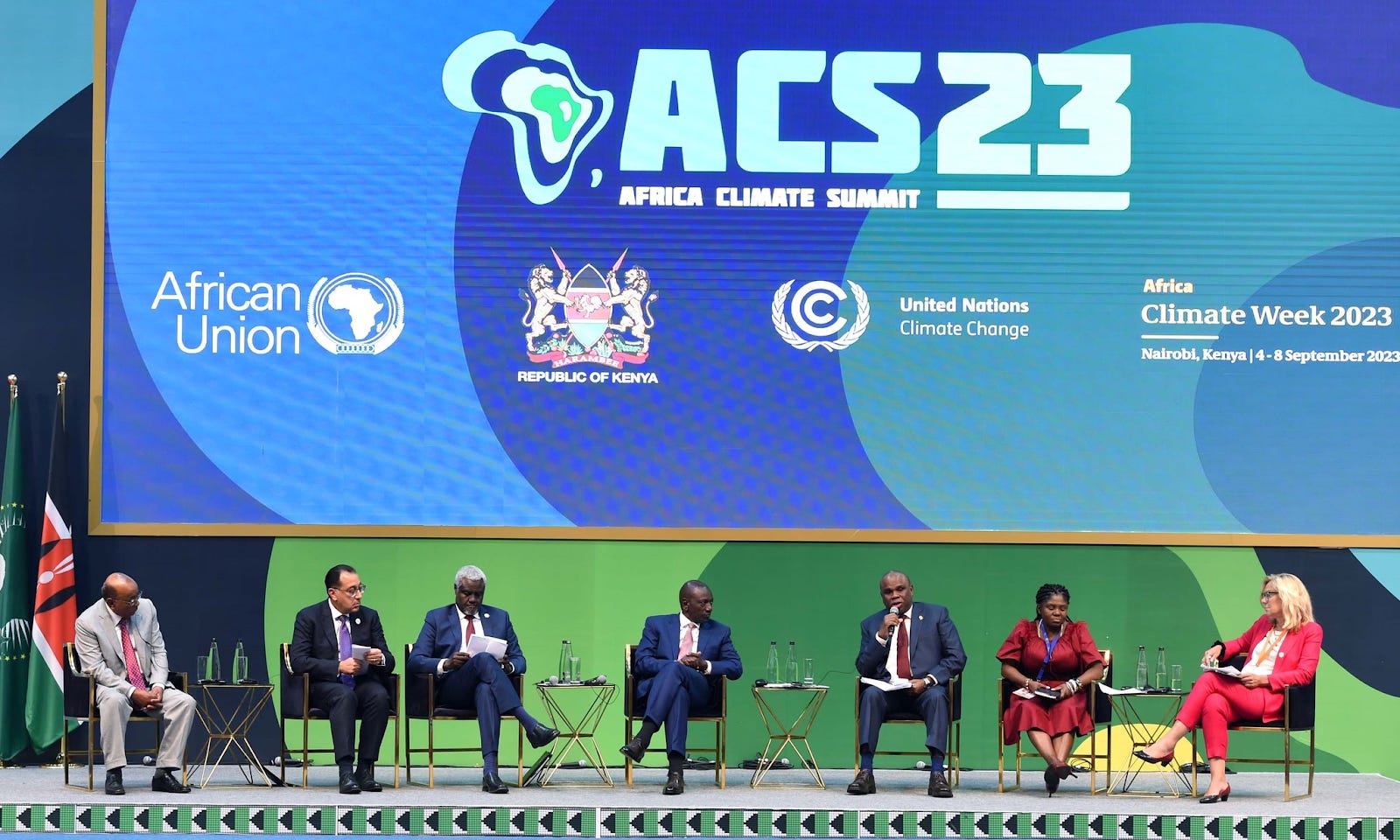
The continent hosted its first-ever Africa Climate Change Summit in September, culminating in the historic “Nairobi Declaration.”
This declaration saw African leaders commit to combat climate change through increased investments, a carbon tax, and sustainable development goals.
However, the fight requires more than just declarations.
This is where climate-focused tech startups take center stage.
Africa’s first-ever Climate Change summit in Nairobi saw leaders commit to combating climate change through increased investments, a carbon tax, and SDGs.
African innovators to the rescue
Over 500 startups have emerged across Africa in the last 15 years, offering innovative solutions in agriculture, clean energy, sustainable materials, e-mobility, and nature-based solutions, per a 2022 report by Briter Bridges.
In Ethiopia, for instance, a booming urban population and single-use plastic have seen waste generation skyrocket from 9,700 tonnes/day in 2015 to 12,200 tonnes/day in 2020.
This trend is fueling environmental and health woes and projections warn this figure could double by 2030.
This is because of how building materials are produced, what materials are used, and the properties’ energy efficiency once they’re up and running.
Kubik’s mission is to build clean and affordable living for all, solving Africa’s housing and waste crises simultaneously.
Its solution boasts several advantages:
Cost-effective: Significantly cheaper than conventional materials
Time-saving: Constructions are twice as fast as traditional methods
Eco-friendly: Over 5 times less polluting than cement
In a recent oversubscribed seed round, Kubik secured $3.34 million to fuel its growth and expand its reach.
This investment affirms the potential of Kubik’s solution to tackle waste, improve housing, and protect the environment.
Buildings account for 40% of total global carbon emissions. Kubik’s mission is to build clean and affordable living for all.
A look at the types of solutions that populate the climate sector reveals that agriculture and energy—specifically pay-as-you-go solar scale-ups—dominate.
However, the space is getting broader with startups addressing a range of issues.
Here are some other startups leading the charge:
Coliba: Specializing in the collection and recycling of plastic waste, which is converted into granules and then resold to various industries.
Amini: Bridging the environmental data gap with AI-powered sensors that monitor air quality and water resources.
Figorr: Tackling food waste through its AI-powered platform that connects farmers with buyers for unsold produce.
Powerstove: Providing clean and efficient cookstoves that reduce reliance on firewood and improve health.
Daystar Solar: Bringing affordable solar power to off-grid communities, empowering households and businesses.
PEG Africa: Offering pay-as-you-go solar home systems, reaching over 1m customers across Ghana, Senegal, Mali, and Ivory Coast.
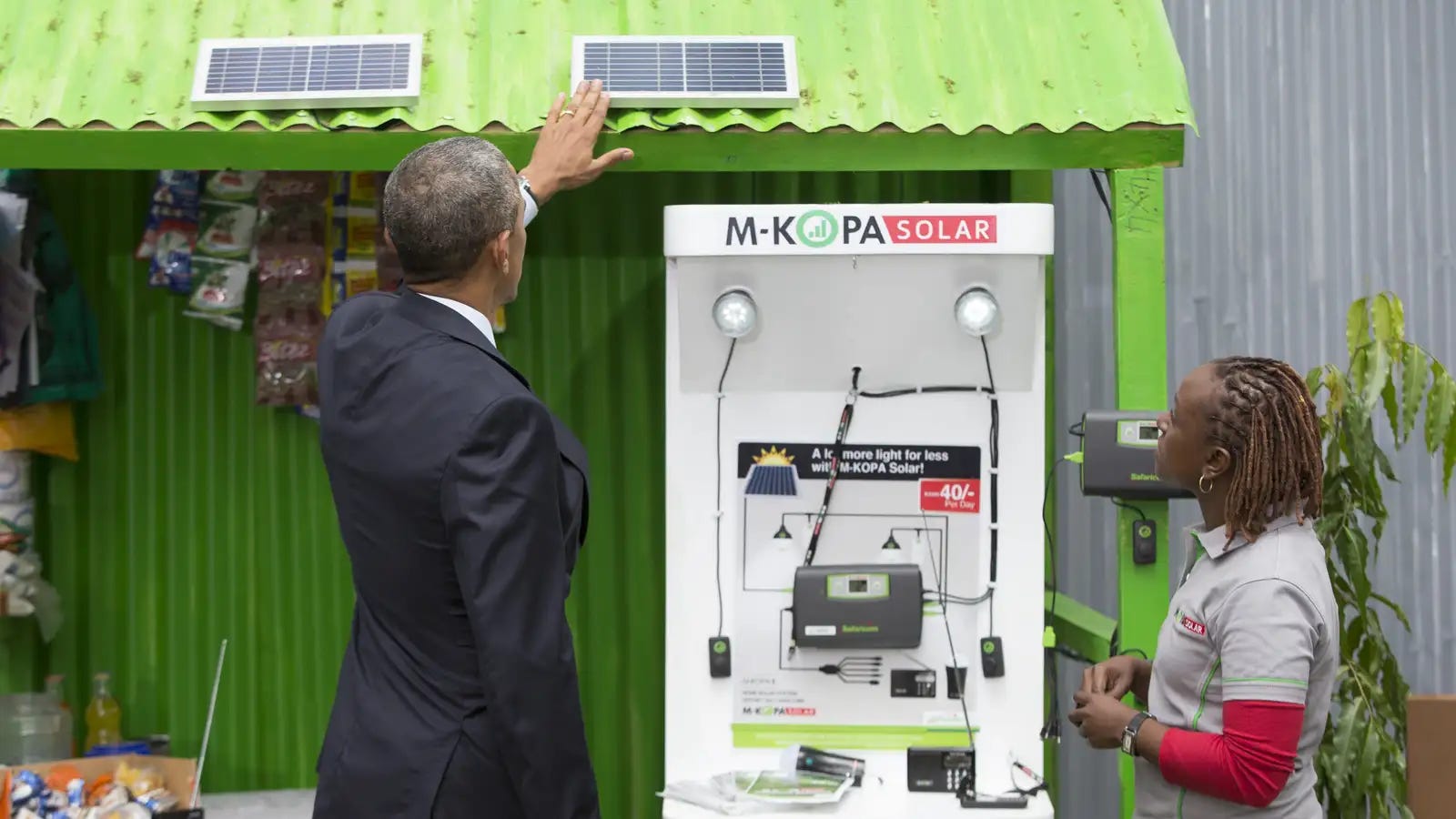
M-Kopa: Another Kenyan champion, providing clean energy solutions to off-grid communities through its pay-as-you-go model.
Solar Freeze: Empowering smallholder farmers with off-grid solar-powered refrigeration to preserve their produce.
BasiGo: An electric bus company leasing vehicles to bus owners on a pay-as-you-drive model, facilitating the transition to clean mobility without high upfront costs.
The rise of these startups is fueled by a surge in investor backing.
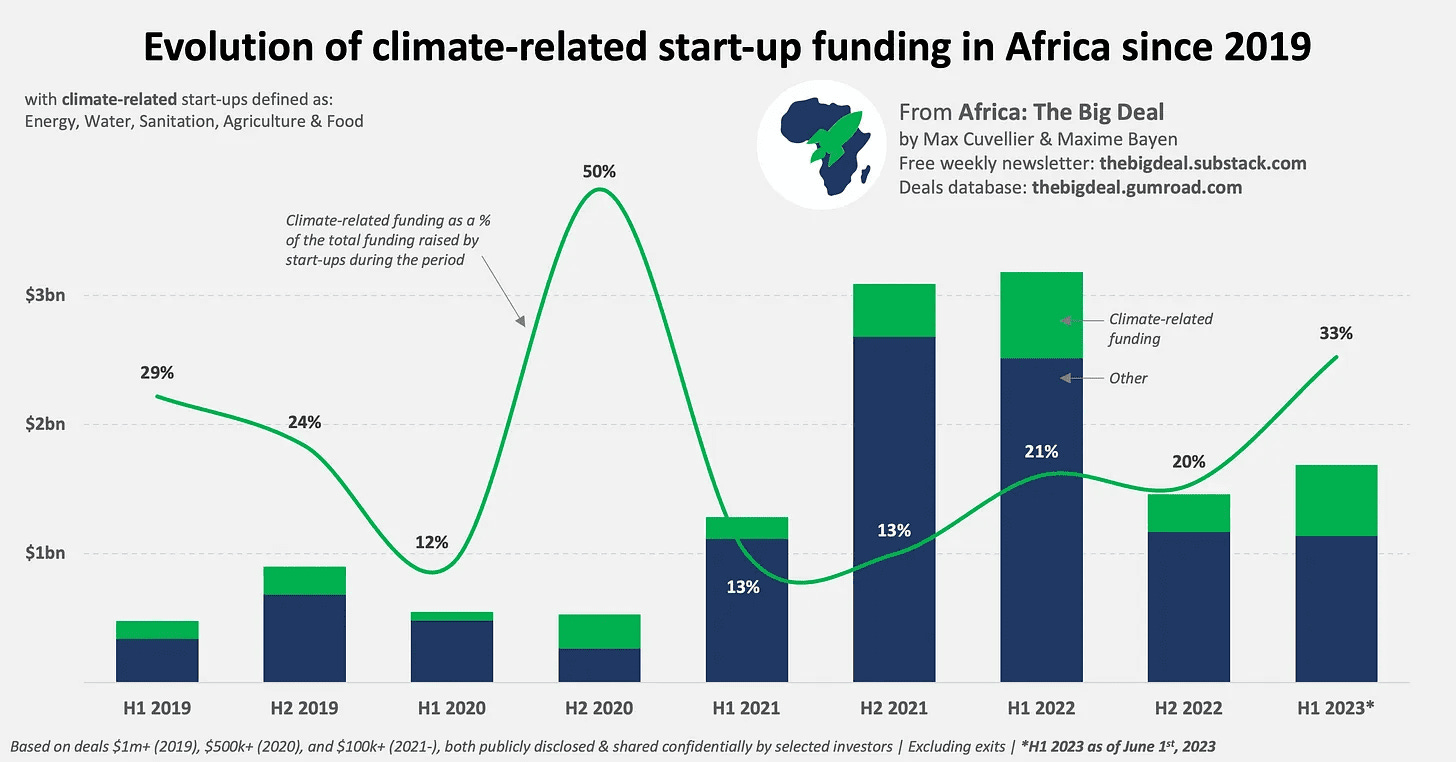
Out of the 500 identified climate-tech startups on the continent, 147 have secured funding since 2015.
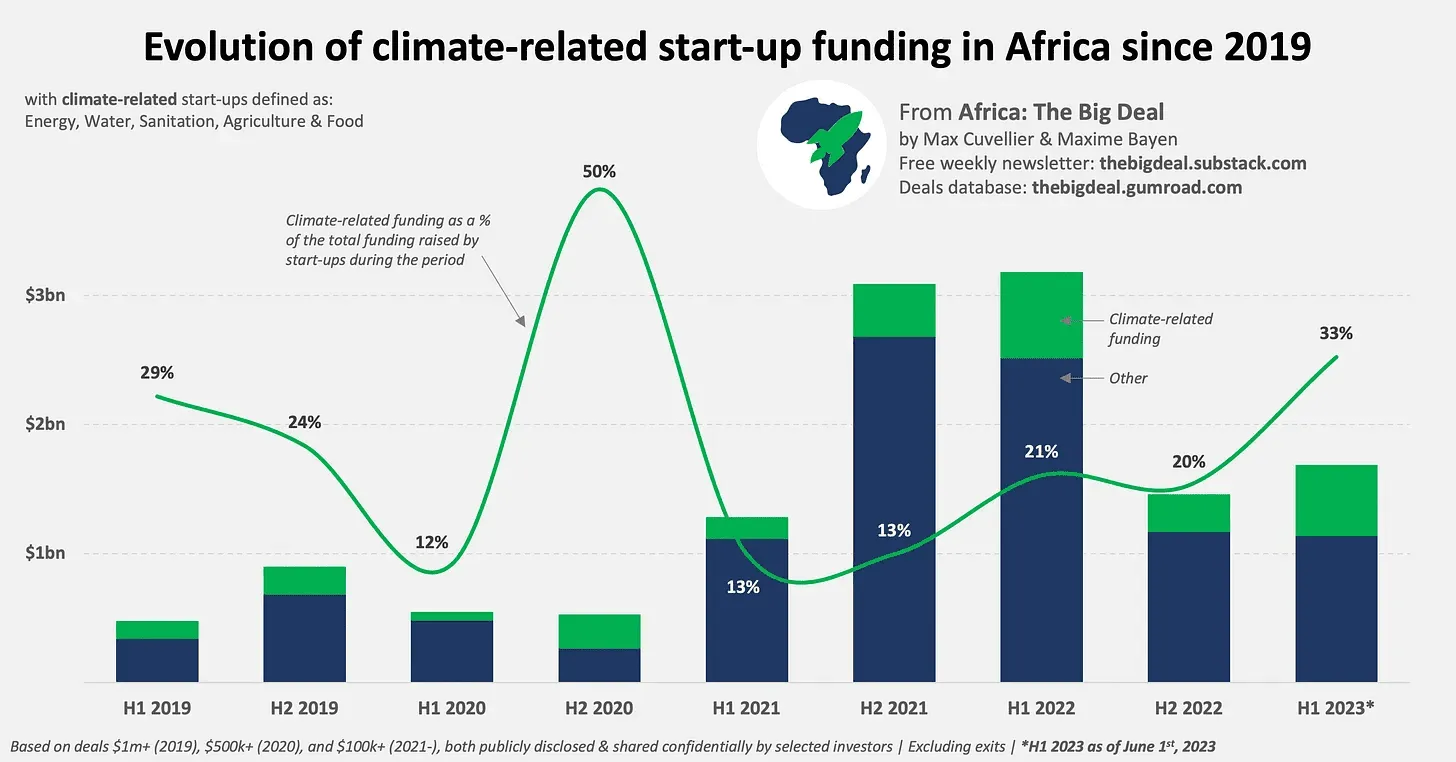
More so, at least 230 deals over $1m have been signed in the climate-tech space since 2019, just over 20% of all the deals signed in Africa.
Around 73% of this funding went to energy startups.
Image credit: The Big Deal
This trend is set to be further bolstered by the launch of new climate-tech funds over the past year—despite the global VC funding cooldown.
Some of these include…
Pan-African venture firm Novastar’s $200m Africa People + Planet fund for startups developing agriculture and climate solutions.
VC firm Equator’s $40m fundraising to back seed and Series A startups in energy, agriculture, and mobility.
Catalyst Fund’s new climate-focused $30m fund, now investing in its first cohort of startups.
Satgana, a new climate tech firm launched in late 2022, with plans to allocate up to 40% of its funds to “planet-positive” startups in Africa.
There’s the $250m AfricaGoGreen Fund (AAGF), which closed the second tranche of its fundraising in February and counts pay-as-you-go solar providers BBOXX and Solarise as part of its portfolio.
Also, the Energy Entrepreneurs Growth Fund (EEGF), backed by Shell and Canadian investor FinDev, raised $110m for startups that increase access to clean and reliable energy for African households and businesses.
E3 Capital (formerly Energy Access Ventures)’s Low Carbon Economy Fund for Africa (E3LCEF), hit its first close in May at $48m.
Oxfam Novib and Goodwell also recently launched a new $22m Pepea fund to provide venture debt to startups in this space.
Climate venture builder, Persistent Energy, recently closed a $10m Series C funding round to strengthen its team and scale climate activities in Africa.
Also, the Climate Investment Funds (CIF), implemented by the AfDB, has supported the development of 39 investment plans across 27 African countries to unlock climate action.
PEG Africa offers pay-as-you-go solar home systems, reaching over 1m customers across Ghana, Senegal, Mali, and Ivory Coast.
These dedicated funds show a sustained commitment to supporting climate-tech innovation in Africa.
While the funding landscape is promising, challenges remain.
Additionally, the low number of exits (10, all in energy) indicates a long road ahead for commercial capital to enter at scale.
M-Kopa provides clean energy solutions to off-grid communities through a pay-as-you-go model.
Still, the momentum is undeniable.
Climate-related startups in Africa have raised $3.4bn between 2019-2023, nearly 60% of the total funding volume invested in the much more mature fintech sector.
That, coupled with the emergence of innovative solutions and government-backed initiatives, demonstrates a commitment to tackling climate challenges.
Africa is not just facing the brunt of climate change; it is also becoming a breeding ground for innovative solutions that can inspire the world.
The annual Partech Africa Tech Venture Capital report offers valuable insights into the evolution of the African tech ecosystem.
The 2023 edition reveals a significant funding slowdown aligned with global VC trends, yet highlights areas of resilience.
Here are the key takeaways.
Halved Funding Reflects Global Downturn
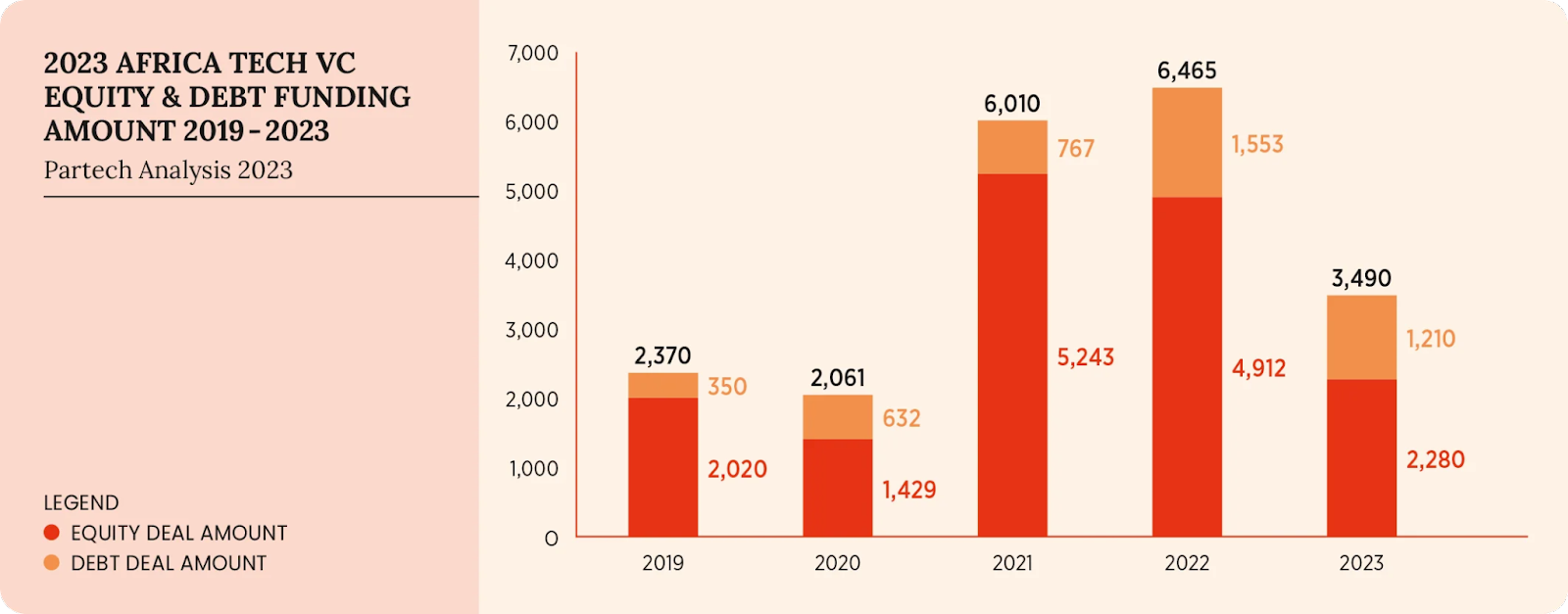
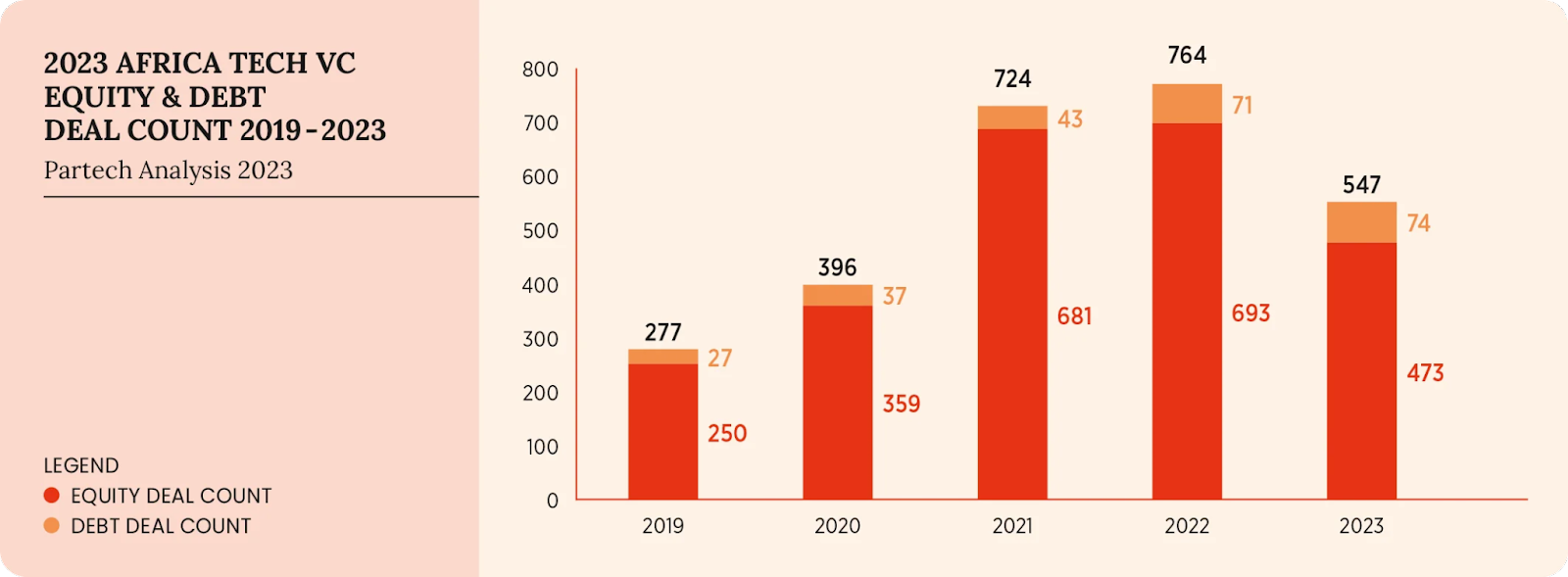
In 2023, African startups raised $3.5B, a 46% annual drop, spread across 547 deals (-28%). Equity specifically saw a 50% funding decrease.
This mirrors the global VC funding crunch as investors became more cautious. However, Africa still captivated over 500 investors, proving continued strong interest.
Drop Seen at All Funding Stages
The report shows drops across all funding stages, but the largest was in growth rounds (-31% ticket average). Seed and Series A shrank moderately (8-16%), while Series B held steady.
This indicates investors focused on supporting existing portfolio companies rather than new investments.
Top 4 Markets Still Lead, With Shifts
The African “big four” markets —South Africa, Nigeria, Egypt, and Kenya—still dominate, securing 79% of deals. However, their deal share fell somewhat (from 77%), signaling increasing activity across the continent.
South Africa took first place by total equity raised at $548M. Yet Kenya captured the top spot for overall funding at $719M thanks to major debt financing. So these two nations currently lead Africa’s tech funding.
Nigeria persisted as #1 by deal count, despite its equity funding being halved. Meanwhile, Egypt took the biggest hit among the top four, with equity deals plummeting 58%.
Francophone Rising
Encouragingly, 52% of African countries saw a tech investment, up from 46% in 2022. Francophone Africa enjoyed substantial growth taking 15% of equity (up from 11%) across 20% of deals. This indicates strengthened VC attention beyond the major four tech hubs.
As in previous years, fintech ranked first in both deals (113) and total equity funding ($852M).
E-commerce and cleantech tied for second place with 13% shares each. Fintech’s dominance shows Africa’s immense need for financial inclusion and payment solutions.
Funding to Women Founders Growing
Startups with female founders raised 25% of equity deals, up 3 percentage points from 2022. They also secured $392M in equity, representing 17% of total equity versus 13% last year. While still low relative to the population, VC backing for women tech leaders gained meaningful ground.
Debt Emerges as Complement to Equity
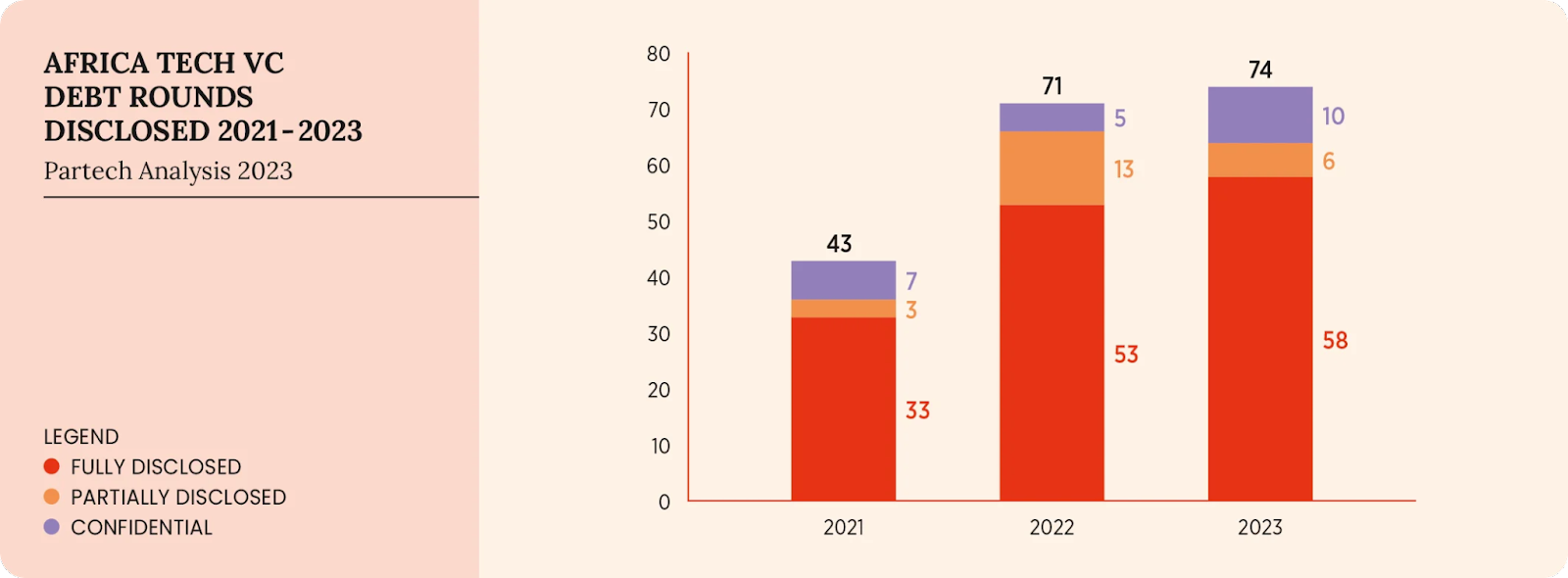
The report highlights debt’s increasing relevance, making up 35% of total funding versus just 24% in 2022.
Kenya led debt financing with a 32% share, focused heavily on cleantech and fintech companies.
As equity tightens, debt provides a viable capital alternative for maturing African startups.
In summary, while the Africa tech funding environment grew markedly more challenging in 2023, the sector appears to be weathering the storm.
Key players retained respectable funding levels given the climate, investors continued backing a breadth of markets and founders, and debt helped cushion the equity slowdown.
The Partech report suggests cautious optimism for African tech growth returning post-downturn. Key metrics like deal count and women’s funding underscore the industry’s underlying momentum.
Want to learn more about investment trends and access opportunities in Africa? Download the Daba application from your app stores today!
La Coupe d’Afrique des Nations (CAN) 2023 débute ce samedi avec la Côte d’Ivoire en tant que pays hôte face à la Guinée-Bissau.
Malgré le fait que le tournoi soit officiellement désigné comme les finales de 2023, il se déroule en 2024.
Les champions en titre, le Sénégal, entrent dans la compétition en tant que favoris, cherchant à devenir la quatrième équipe à remporter consécutivement la CAN, un exploit réalisé pour la dernière fois par l’Égypte de 2006 à 2010.
Pour analyser les potentiels vainqueurs, BBC Sport et Opta utilisent un modèle de prédiction basé sur l’intelligence artificielle.
Sadio Mané tient le trophée de la CAN après que le Sénégal soit sorti victorieux lors de la dernière édition du tournoi. Crédit image : Eurosport
Ce modèle examine la probabilité des résultats des matchs – victoire, match nul ou défaite – en incorporant les cotes du marché des paris et les classements des équipes d’Opta, basés sur les performances historiques et récentes.
Il prend également en compte la force de l’adversaire et la difficulté du parcours jusqu’à la finale, en tenant compte de la composition des groupes et des éventuels affrontements en phase éliminatoire.
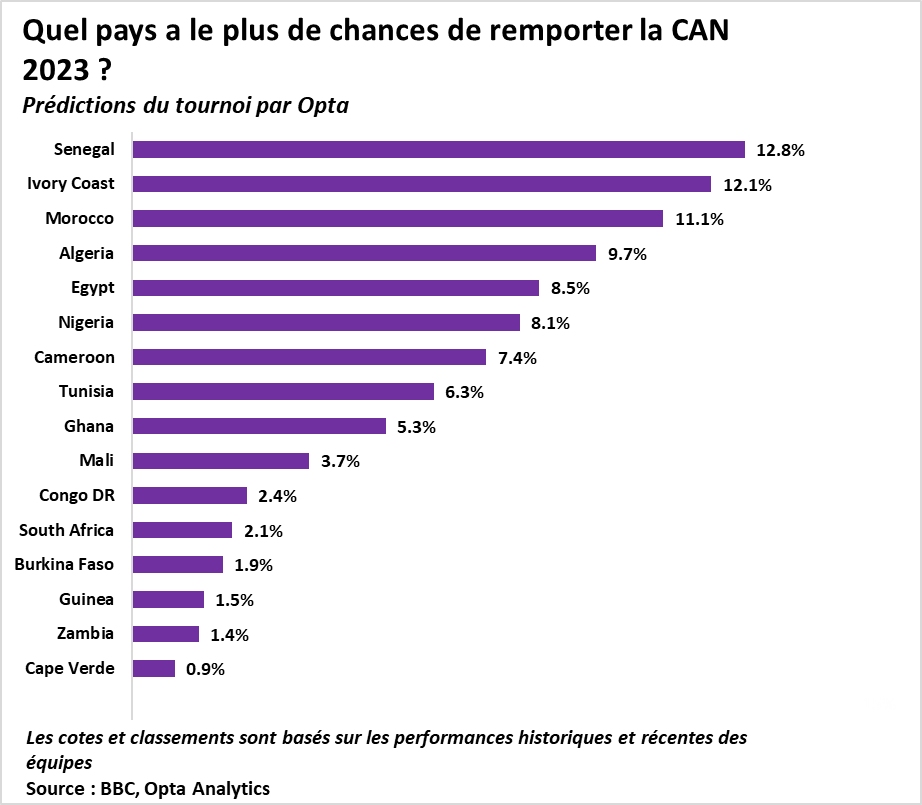
Selon le modèle de prédiction, le Sénégal émerge en tant que favori avec une probabilité de 12,8 % de remporter le trophée.
La Côte d’Ivoire suit de près avec une probabilité de 12,1 %, cherchant à remporter leur troisième titre de la CAN après leurs victoires en 1992 et 2015.
L’Égypte, pays hôte en 2006, reste le dernier pays hôte à avoir remporté le tournoi.
Le Maroc, cherchant son deuxième titre de la CAN depuis 1976, et l’Algérie complètent le top cinq avec des probabilités de 11,1 % et 9,7 %, respectivement.
L’Égypte, sept fois championne de la CAN, vise la rédemption après leur défaite déchirante face au Sénégal en finale en 2021.
Mohamed Salah, qui a connu la défaite en finale en 2017, est impatient de remporter son premier titre de la Coupe d’Afrique des Nations.
Le modèle de prédiction donne à l’Égypte une probabilité de 16 % d’atteindre une autre finale cette année, marquant un éventuel retour depuis leur dernier triomphe en 2010.
Les sept meilleures équipes selon le modèle de prédiction comprennent également le Nigeria et le Cameroun, tous deux des poids lourds du football africain.
Le Nigeria, trois fois champion de la CAN (1980, 1994 et 2013), a une probabilité de 8,1 % de remporter le trophée, avec Victor Osimhen, le Joueur de l’Année africain 2023, se démarquant comme un buteur redoutable.
Le Cameroun, cinq fois champion (1984, 1988, 2000, 2002 et 2017), a une probabilité de réussite de 7,5 %.
La performance impressionnante d’Osimhen lors des qualifications, où il a marqué 10 buts pour le Nigeria, met en avant la puissance de marquage des Super Eagles, avec 22 buts au total, soit sept de plus que toute autre équipe.
L’équilibre entre les réalisations historiques, les performances récentes des équipes et les contributions individuelles des joueurs façonne les prédictions, faisant de la CAN 2023 une perspective passionnante pour les fans et les passionnés de football.
En conclusion, alors que la Coupe d’Afrique des Nations 2023 se déroule en 2024, la compétition est sur le point de livrer des moments palpitants.
Le modèle de prédiction basé sur l’intelligence artificielle suggère que le Sénégal, la Côte d’Ivoire et l’Égypte sont les principaux prétendants, tandis que le Nigeria et le Cameroun, avec leur riche histoire du football, ajoutent une couche supplémentaire d’excitation au tournoi.
Le terrain est prêt pour une bataille intense alors que ces équipes luttent pour le titre prestigieux du football africain.
Divulgation : Ce blog a été sourcé à partir de Opta Analyst et régénéré à l’aide de l’IA.
The 2023 Africa Cup of Nations (Afcon) kicks off this Saturday with Ivory Coast hosting Guinea-Bissau.
Despite the tournament being officially labeled as the 2023 finals, they are taking place in 2024.
The reigning champions, Senegal, enter the competition as favorites, seeking to become the fourth team to win consecutive Afcons, a feat last achieved by Egypt from 2006 to 2010.
BBC Sport and Opta utilize an artificial intelligence prediction model to analyze the potential winners.
Sadio Mane holds the AFCON trophy after Senegal emerged victorious in the last edition of the tournament. Image credit: Eurosport
This model examines the probability of match outcomes—win, draw, or loss—by incorporating betting market odds and Opta’s team rankings, which are based on historical and recent performances.
It also considers opponent strength and the difficulty of the path to the final, factoring in group compositions and potential knockout stage match-ups.
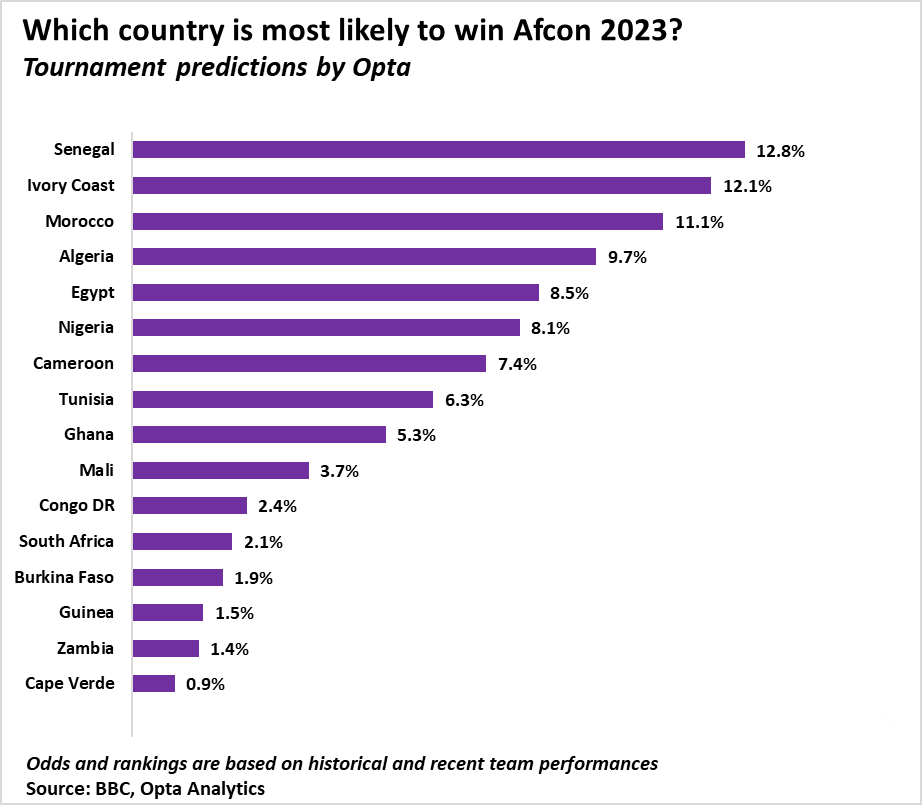
Senegal emerges as the front-runner with a 12.8% chance of lifting the trophy.
Ivory Coast closely follows with a 12.1% probability, aiming for their third Afcon title after victories in 1992 and 2015.
Egypt, the host nation in 2006, remains the last host to win the tournament.
Morocco, seeking their second Afcon title since 1976, and Algeria round off the top five contenders with 11.1% and 9.7% chances, respectively.
Egypt, a seven-time Afcon champion, eyes redemption after their heartbreaking loss to Senegal in the 2021 final.
Mohamed Salah, who experienced defeat in the 2017 final, is eager to secure his first Africa Cup of Nations title.
The prediction model gives Egypt a 16% chance of reaching another final this year, marking a potential comeback since their last triumph in 2010.
The top seven teams in the predictor model include Nigeria and Cameroon, both heavyweights in African football.
Nigeria, three-time Afcon winners (1980, 1994, and 2013), have an 8.1% chance of lifting the trophy, with Victor Osimhen, the 2023 African Footballer of the Year, standing out as a potent goalscorer.
Cameroon, five-time champions (1984, 1988, 2000, 2002, and 2017), hold a 7.5% chance of success.
Osimhen’s impressive performance in the qualifiers, where he scored 10 goals for Nigeria, emphasizes the Super Eagles’ goal-scoring prowess, with 22 overall goals, seven more than any other side.
The balance between historical achievements, recent team performances, and individual player contributions shapes the predictions, making the 2023 Afcon an exciting prospect for fans and football enthusiasts alike.
In conclusion, as the 2023 Africa Cup of Nations unfolds in 2024, the competition is poised to deliver thrilling moments.
The AI prediction model suggests Senegal, Ivory Coast, and Egypt as the primary contenders. Nigeria and Cameroon, with their rich footballing history, add an extra layer of excitement to the tournament.
The stage is set for an intense battle as these teams vie for the prestigious title in African football.
Disclosure: This blog was sourced from Opta Analyst and re-generated using AI.
There are not many places to look but up in the new year for African tech stakeholders after what turned out to be a tough 2023 for startups globally.
This year, budgets and valuations were cut, business models revised, layoffs were frequent, and some startups shuttered as the harsh realities of a funding downturn, mismanagement, and fraud took their toll on African tech.
It’s time to take stock of the last 12 months in what’s been a rollercoaster year. Read on to discover the major themes in Africa’s tech ecosystem.
The venture funding market shrinks
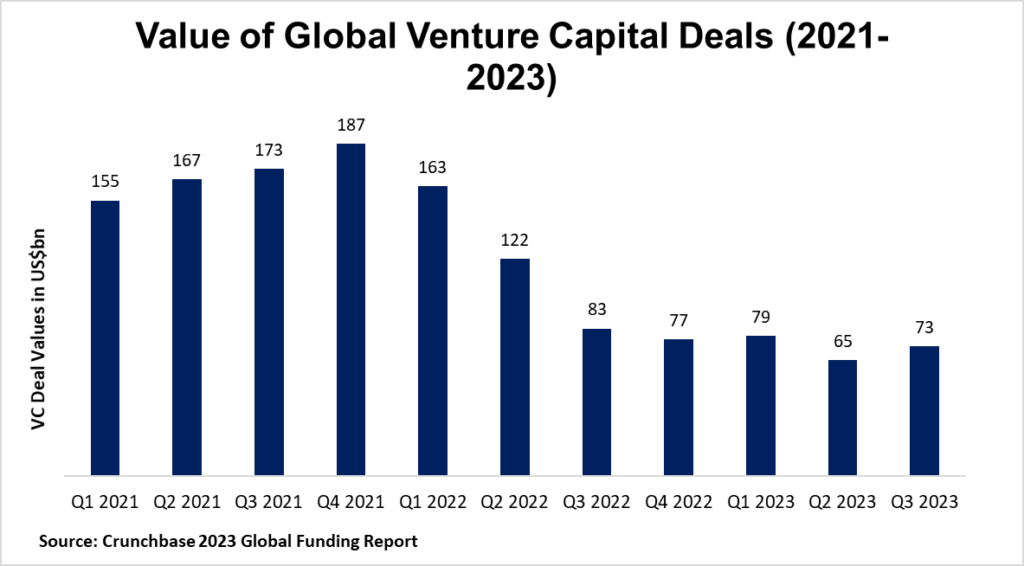
The exuberance of 2022’s VC landscape gave way to a stark reality in 2023, with funding plummeting by around half globally in the first half of the year.
This dramatic shift coincided with hikes in interest rates, which had a chilling effect on fundraising. For every 1% hike in interest rates, there was an alarming 3.2% decline in VC capital.
This tightening environment not only reduced the pool of VC money available to startups but also made debt financing, a potential alternative, a less viable option due to higher borrowing costs.
After a bullish 2022 in which Africa was the only continent to record growth in venture funding values, there was no escaping the downturn this year.
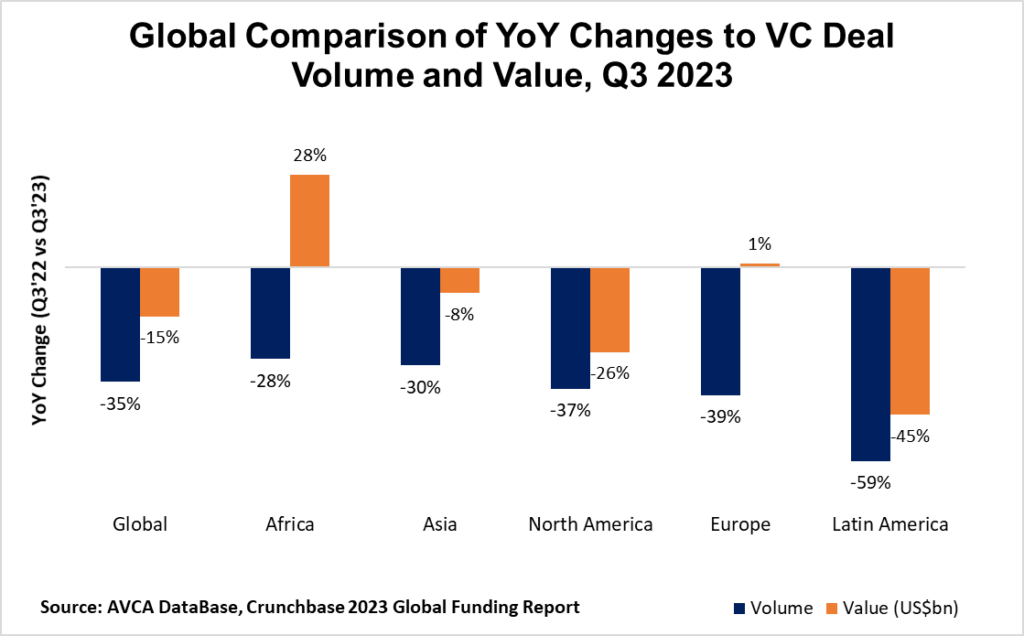
The funding winter reached the continent in the H1 2023. Startup funding plunged to just over $1bn, a stark drop from $3.5bn the year before, per AVCA data.
Investors completed 263 deals – a 40% reduction in both deal volume and funding compared to the previous year.
Although African startups staged an impressive comeback in Q3 2023, with funding jumping by 28% compared to the year before.
The general slowdown prompted a reshuffle, with investor focus shifting towards nurturing young startups in their early stages or mature players nearing unicorn status.
Most likely Africa’s VC funding figures fell far from 2022 levels. The final tally as of Q3 2023 to date, per AVCA, stood at $2.95bn – down from the $4.3bn that was raised by the same point last year.
That means Africa’s venture capital industry managed to attract two-thirds (69%) of the capital it accrued by September 2022, and a more disappointing 56% of the total funding last year.
While VC funding is harder to come by, Development Finance Institutions (DFIs)—such as the IFC, BII, US DFC, and Proparco—are becoming more active in the tech startup landscape.
Venture debt & hybrid rounds become more frequent
2023’s funding scorecards are yet to roll out but available estimates suggest the continent’s startups still managed to attract more than $5bn.
Compared to previous years, a higher portion of the total funding is likely to be in the form of venture debt, which has become an alternative source of capital for African startups.
Notable in startup fundraising announcements this year is the growing frequency of mixed equity and debt funding rounds.
Examples include:
Okra Solar’s Series A round ($7.85m equity and $4.15m debt);
Complete Farmer’s pre-Series A funding round ($7m equity and $3.4m debt)
Wetility’s $50m fundraising included a $33m commercial debt package from a consortium of commercial and development banks
While venture debt shines as a catalyst for early-stage ventures, providing crucial working capital to fuel their growth, it’s also increasingly powering expansion for more established startups.
This is the case with:
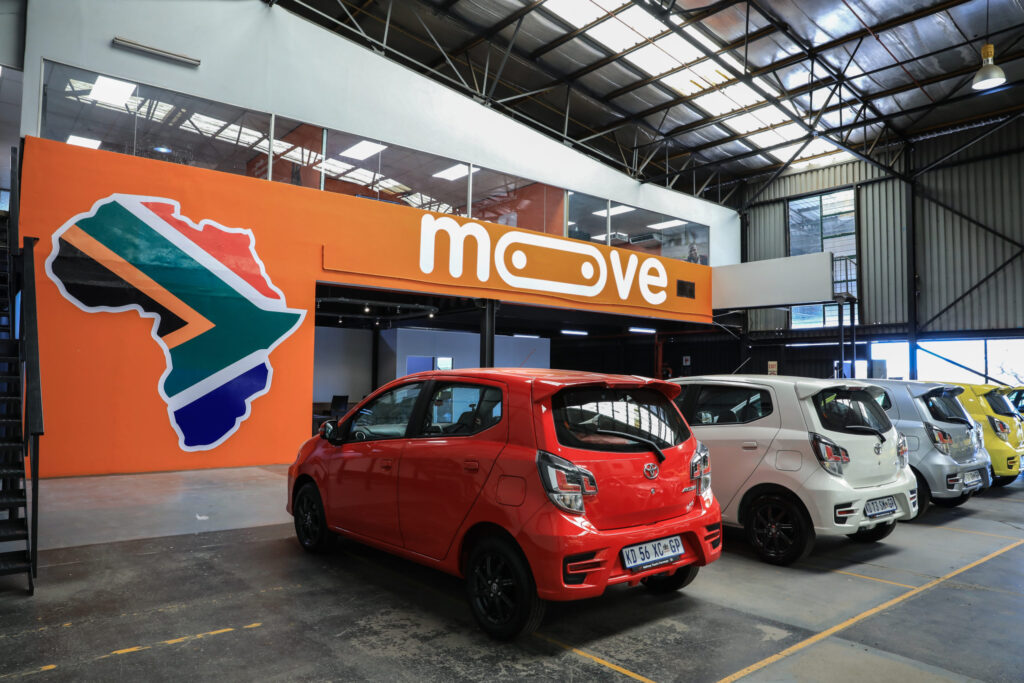
Mobility FinTech startup Moove Africa. It has raised $325m to date ($150m in equity and over $175m in debt)
Kenyan solar home system provider d.Light’s $125m securitization facility. The company’s total securitized financing is $490m since 2020
An uptick in startup shutdowns, pivots & downsizing
With global macro headwinds seeing investors cut fewer checks and some reportedly renege on commitments, a slew of startups were forced to downsize, pivot, or in many cases, close up shop.
At least 15 African startups shuttered this year, including those with once highly-celebrated status on the continent: 54 Gene, Dash, Sendy, WhereIsMyTransport, Lazerpay, Zumi, Zazuu, Hytch, Okada Books, Pivo, Vibra, Redbird, Bundle Africa, Spire, Qefira.
Combined, these startups raised over $200m in disclosed VC funding while operational.
Meanwhile, others like Copia, MarketForce, and Twiga Foods have had to change the way they operate.
It’s noteworthy that the funding slowdown has hit a certain type of African startups hardest—well-funded ventures chasing growth-at-all-costs strategies.
Cleantech/climate-tech now as popular as fintech
The tide is rising for climate tech (comprising innovations across agriculture, clean energy, sustainable materials, environmental sustainability, e-mobility, and nature-based solutions) in Africa.
Last year, funding to the sector grew 3.5 times to over $860m, making it Africa’s most funded after fintech.
It has maintained the second spot so far this year, per AVCA report. Data from Africa: The Big Deal shows the sector accounts for 32% of total VC funding as of Q3, behind fintech’s 35%.
And over the past 12-18 months, several VC firms—among them Satgana, Catalyst Fund, Equator, and EchoVC—have introduced funds to support startups in the sector.
The timing of this surge in climate funding couldn’t be better as Africa grapples with the increasingly severe impacts of climate change, we write in our Pulse54 newsletter, which explores climate tech in general and active players in the sector.
Spotlight on fraud & founder misconduct
Amidst the remarkable growth of Africa’s tech ecosystem, shadows loom over malpractices that impede the full potential and integrity of the continent’s startup landscape.
In 2023 alone, numerous unsettling reports emerged, depicting common themes such as financial misappropriation, deficient or corporate malfeasance, instances of sexual harassment, and the prevalence of toxic work cultures.
Startups like Ghana’s Dash and Float, Egypt’s Capiter, South Africa’s Springleap, and Nigeria-based companies such as PayDay, 54Gene, and Patricia were implicated.
More recently, Tingo was charged by the US SEC, accused of engaging in a “massive fraud” involving “billions of dollars of fictitious transactions,” all under the leadership of CEO Dozy Mmobuosi.
The lessons drawn from the challenges of 2023 underscore the critical need for regulatory clarity to eliminate grey areas in compliance.
Furthermore, investors must prioritize ensuring proper governance to safeguard the integrity of the African startup ecosystem.
Mergers & acquisitions become a survival strategy
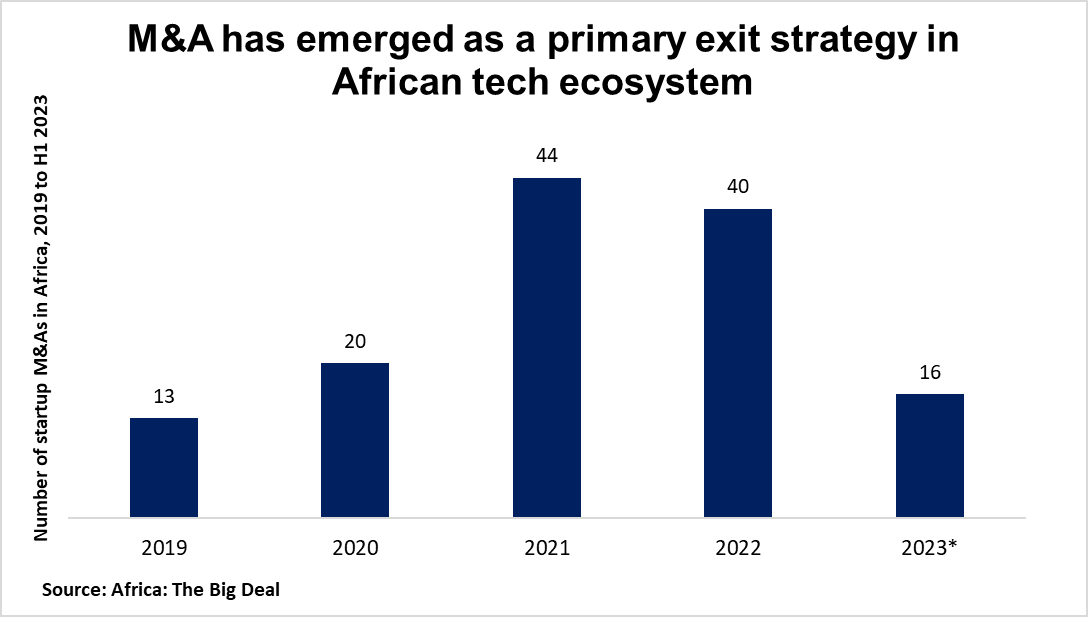
Mergers and acquisitions (M&A) have emerged as a primary exit strategy and, in the current depressed funding environment, a lifeline for African startup founders.
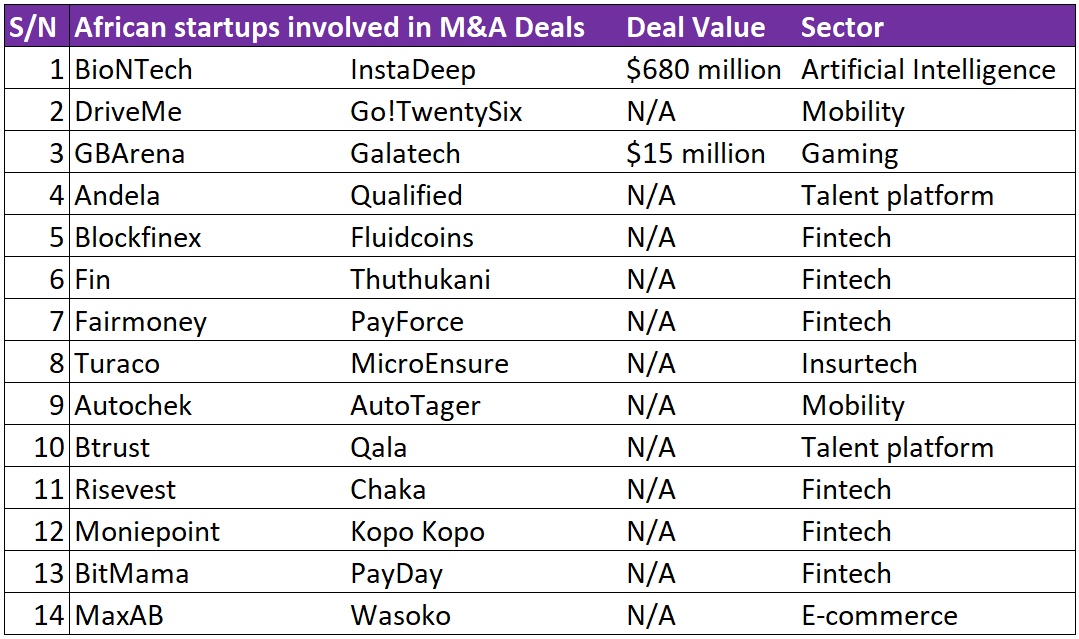
In Q1 2023 alone, seven M&A deals took place in the African startup ecosystem worth over $710m. Tunisia-based InstaDeep’s $682m acquisition in January by Germany’s BioNTech accounted for much of that.
By the end of the year’s first half, there had been at least 16 M&A deals per Big Deal data. About half of them reportedly involve struggling startups.
While this year’s total is likely to be some way off 2022’s 44 deals, one fact remains true: M&As have become a prominent feature of the African tech ecosystem.
Limited funds and the fragmented nature of the African tech market are major drivers.
The presence of numerous small and medium-sized companies across various regions and sectors makes consolidation through M&As a strategic move.
This approach creates larger, more diversified startups that can better compete globally and attract investment.
In addition, African startups are currently viewed as less liquid assets compared to other markets, primarily due to limited exit opportunities.
Thus, as the quest for a reliable path to liquidity in the African tech ecosystem grows, M&As become a viable option for venture capitalists and investors to explore.
Other noteworthy moments and highlights of the year
Starlink, a satellite internet service of Elon Musk-owned SpaceX, became operational in 6 African countries
And digital infrastructure, especially data centers, continues to draw the attention and backing of investors—from telco giants to private equity firms.
Closing Notes
As 2023 hurtles to a close, the question on everyone’s mind is will 2024 be better?
Perceptions of industry performance and expectations for the future vary.
Flagging. That’s how we would describe the African tech startup funding scene in 2023.
Global macro headwinds saw investors cut fewer checks and some reportedly backed down from commitments, forcing a slew of startup shutdowns and downsizing.
While on the surface, it seems Africa’s VC funding figures fell far from 2021 and 2022 levels, available estimates suggest the continent’s startups still managed to attract more than $5 billion.
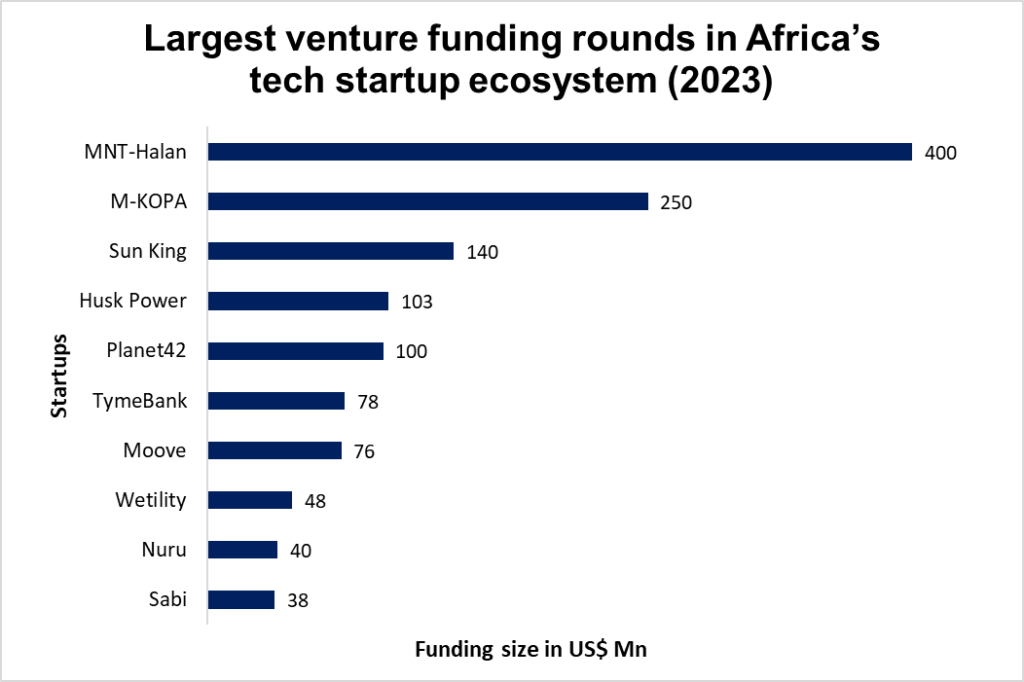
Before the year’s scorecards start to roll out, we take a look at the top 10 largest fundraising rounds in the African tech startup industry this year and the trends they reveal.
Fewer mega-deals (just four >$100m rounds vs nine in 2022):
This signifies a shift towards cautious optimism from investors.
While big bets still happen, they’re rarer, with investors preferring to spread their bets on multiple promising startups.
This could lead to a more sustainable ecosystem, with startups forced to focus on stronger fundamentals and traction before securing large funding rounds.
MNT-Halan‘s $400 million round in Egypt and M-KOPA‘s $250 million in Kenya are rare exceptions, highlighting their established market positions and potential for significant impact.
Fintech takes the top spot but the landscape is more diverse:
Fintech remains a dominant sector due to its potential to address financial inclusion challenges in Africa.
However, other sectors like cleantech and mobility are gaining traction, indicating diversification in investor interest.
This diversification can lead to a more balanced and resilient ecosystem, as the success of the startup scene is not solely dependent on one sector.
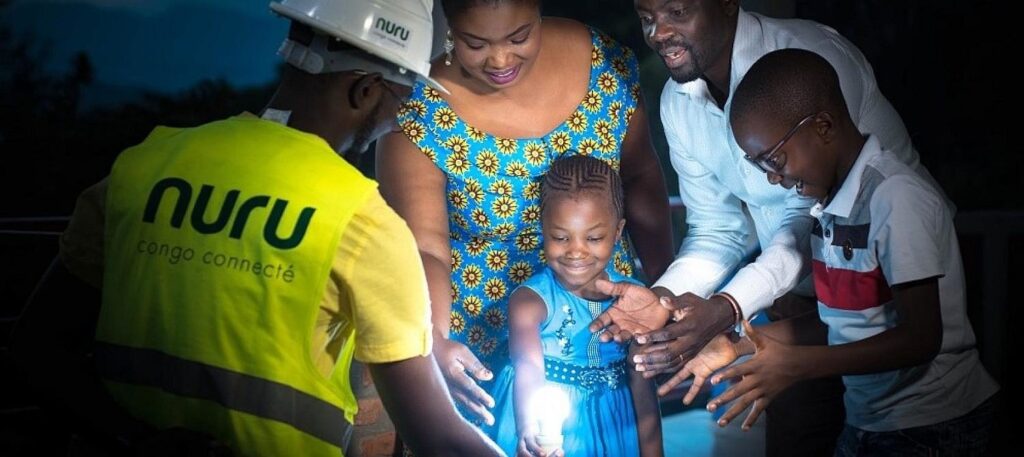
The presence of Husk Power, Wetility, Nuru, Planet42, and Moove in the top 10 shows the growing importance of these sectors in attracting investor attention.
The rising prominence of debt + equity rounds:
This hybrid approach combines the flexibility of equity with the stability of debt, offering startups a more tailored financing solution.
It can be particularly useful for startups with strong revenue models but limited access to traditional equity funding.
This trend could democratize access to funding for startups, especially in emerging markets, as it caters to startups at different stages of growth and risk profiles.
MNT-Halan, M-KOPA, Planet42, and Moove all used debt + equity rounds, demonstrating the growing popularity of this approach.
Geographical distribution
The top 10 deals primarily focus on South Africa, Kenya, and Nigeria, showcasing the continued dominance of these countries in the African startup scene.
The Democratic Republic of Congo (DRC) emerged as a surprise entry in the top 10 thanks to Nuru‘s sizable Series B round.
Series B dominance
The majority of deals being Series B raises indicates a focus on mature startups with proven traction and scalability, further highlighting likely investor risk aversion.
Overall, the top 10 fundraising rounds paint a picture of a resilient African tech ecosystem adapting to a challenging global environment.
While mega-deals were scarce, the diversity of sectors, financing models, and geographical representation suggests potential for sustainable growth in the long term.
Stay tuned to our blog for a broader piece that explores standout trends in Africa’s tech landscape in 2023 and our high-conviction themes for the new year—to be published soon!
Venmo, Cash App, and Zelle are familiar names in the world of mobile-based digital payments in the West, having revolutionized how money is transferred and received by millions of people.
But did you know that Africa has been ahead of the game with its own mobile money systems since as far back as 2007?!
That’s right.
Today, we take you on a journey of how Africa became the biggest mobile money player in the world.
Where it all began
Once upon a time, not too long ago, accessing financial services was a challenge for many Africans. Unlike in the U.S. or Europe, traditional banking services were often very limited, especially in remote and rural areas.
But then mobile money.
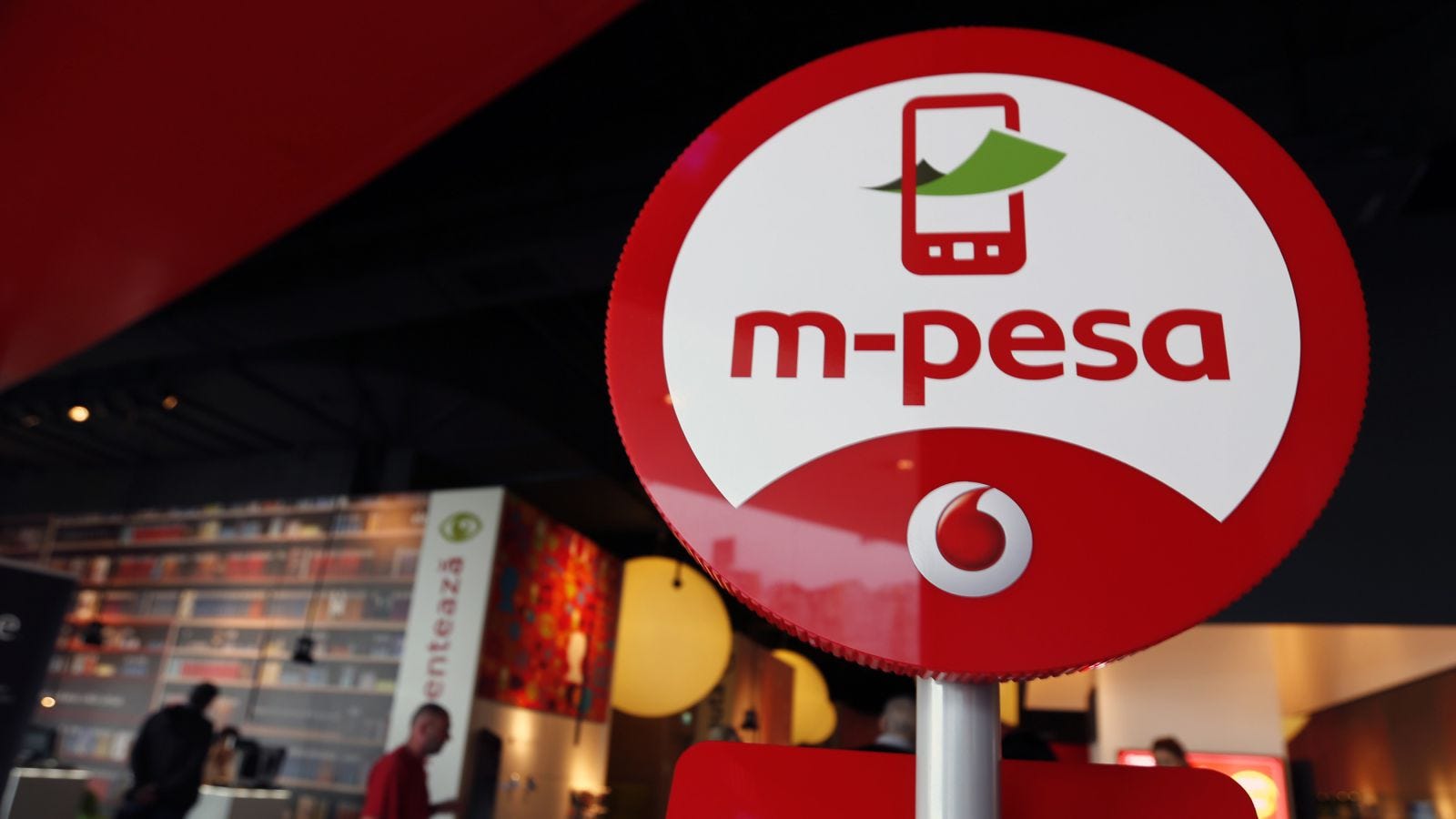
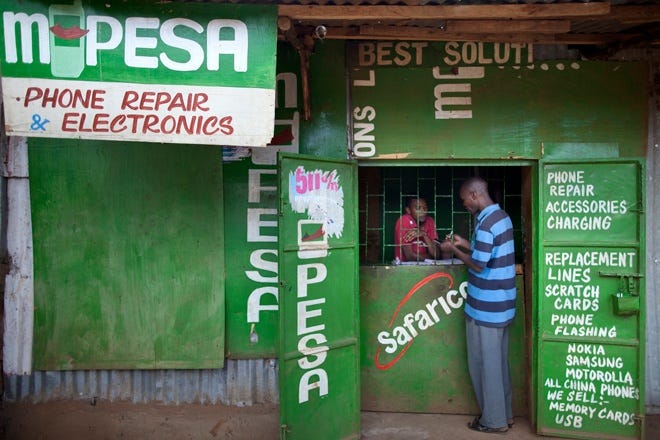
In 2007, Safaricom, a leading mobile network operator in Kenya, launched a mobile money service called M-Pesa. Little did they know that this innovative concept would spark a digital revolution that would sweep across the continent.
M-Pesa, meaning “mobile money” in Swahili, allowed users to save, send, and receive money using just their mobile phones. This groundbreaking innovation proved to be a game-changer, enabling people without bank accounts to participate in the formal financial system.
In 2007, Safaricom, a leading telecommunications company in Kenya, launched a mobile money service called M-Pesa. Image credit: African Markets
The initial idea behind M-Pesa was to create a convenient way for Kenyans to transfer money securely. The service quickly gained popularity, as people in remote areas, where traditional banking services were scarce, embraced it as a means to conduct financial transactions with ease.
In no time, mobile money took root and started to grow, not only in Kenya but also in neighboring countries.
M-Pesa was launched in Tanzania the following year and is now present in at least 10 countries.
So, what made mobile money so popular?
Well, let’s unravel its magic!
Imagine a scenario: a hardworking individual in a rural village wants to send money to their family in the city.
Historically, this would involve a long and costly journey, with the risk of loss or theft. But with a mobile money account, a few taps on a phone screen can instantly transfer funds to their loved ones, efficiently.
One of the key factors that contributed to the rapid adoption of mobile money was its simplicity: all you needed was a basic mobile phone, and suddenly, you had a bank in the palm of your hand.
No more long queues or complicated paperwork. Money transfers could be done with a few simple clicks.
For deposits and withdrawals, mobile money agents, often found in local shops, act as the bridge between the digital and physical worlds, allowing users to convert cash into digital currency and vice versa.
An M-Pesa agent attends to a user. Image credit: HBS Digital Initiative
By 2010, M-Pesa had acquired 10 million active users and by 2016, it served almost 29.5 million active customers through a network of more than 287,400 agents. In the same year, the service processed around 6 billion transactions, peaking in December at 529 transactions every second.
The success of M-Pesa in Kenya sparked a wave of enthusiasm. As word spread about the convenience and reliability of mobile money, its impact began to reverberate throughout the continent.
Impressed by the service, other African countries eagerly jumped on the mobile money revolution, building theirs in M-Pesa’s image.
Over the next few years, the service spread to countries like Uganda, Ghana, Rwanda, and South Africa as mobile network operators and financial institutions started realizing the immense potential of mobile money.
MTN launched its MoMo service in Uganda in March 2009 and in Rwanda in February 2010. Telesom ZAAD in Somaliland in 2009 and Hormuud launched EVC Plus in Somalia in 2011.
By 2011, more than 100 mobile money services were operating in Africa, reaching people who previously had limited access to formal financial services.
Africa continues to lead global adoption
Fast forward to today, more mobile money services have emerged in Africa while mobile money accounts and transaction value on the continent continue to skyrocket.
Africa accounted for up to 70% of the world’s $1 trillion mobile money value in 2021 after mobile money transactions on the continent jumped 39% from $495 billion in 2020 to $701.4 billion.
Last year, that rose a further 22% to a jaw-dropping $836.5 billion (bigger than the GDP of Nigeria, Africa’s largest economy!) but its share of the global $1.26 trillion mobile money value fell to 66.4%.
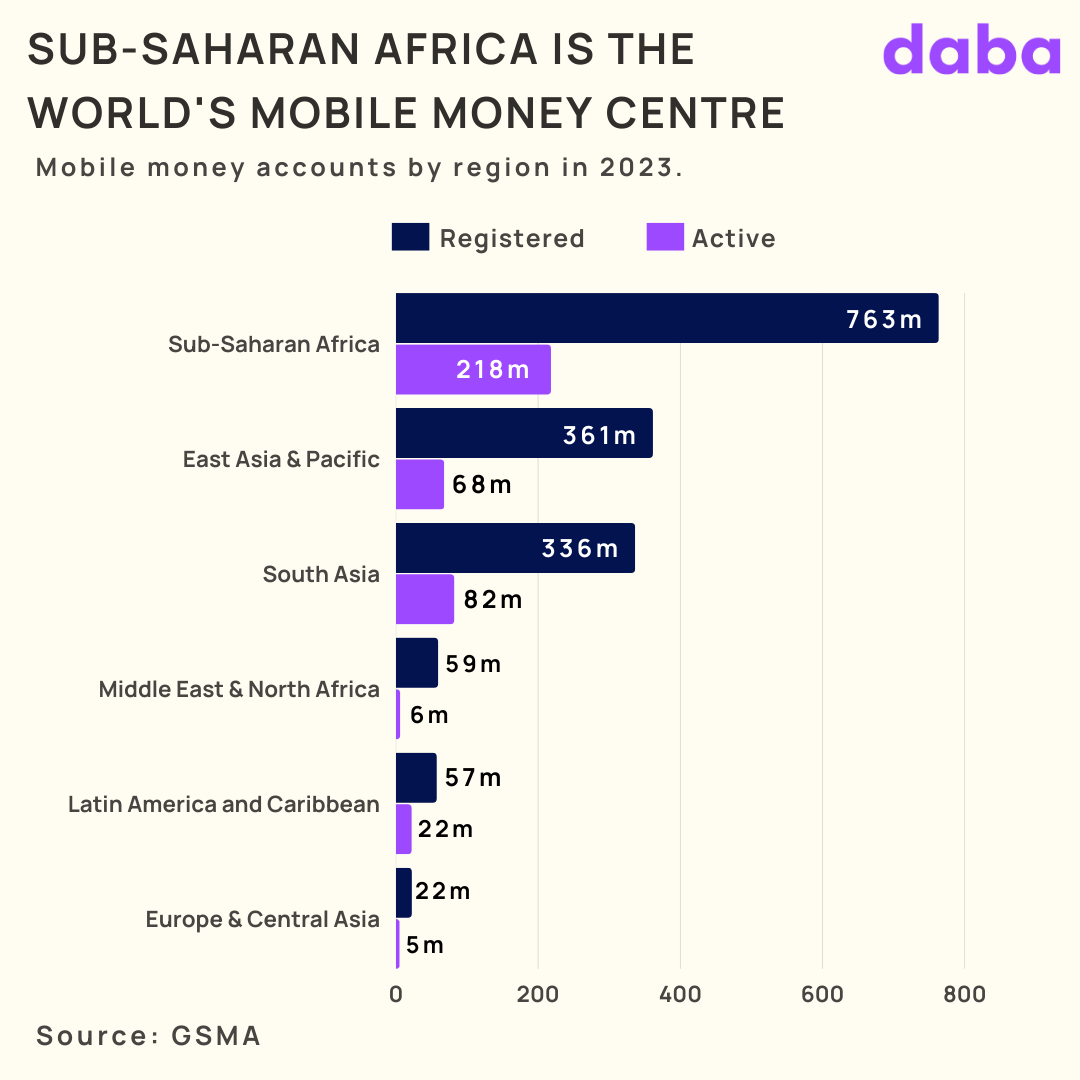
Per GSMA’s 2023 State of the Industry Report, mobile money is growing faster in sub-Saharan Africa than in other regions except for the Middle East & North Africa.
However, it’s not just about the numbers
Perhaps its greatest achievement, mobile money has brought financial inclusion to millions of Africans who were previously excluded from the formal economy.
Data from the World Bank shows that around 45% of people living in Sub-Saharan don’t have access to a bank account. But mobile phones are widespread across the continent and are helping to bridge the financial gap.
As of 2022, Sub-Saharan Africa had up to 763 million registered mobile money accounts, more than double the figures in the next closest region, and more Africans now enjoy access to a whole range of financial services that were previously out of reach.
The innovative service has empowered women entrepreneurs, allowing them to take charge of their finances and contribute to their families’ well-being; facilitated access to education and healthcare; paved the way for exciting innovations such as mobile banking apps and digital wallets.
Beyond money transfers…
Mobile money services in Africa have also quickly evolved beyond simple person-to-person money transfers and cash in-cash out.
Providers have continually expanded their services, introducing innovative features to meet the diverse needs of their users.
For instance, mobile micro-loans and savings accounts empower individuals to access credit and save money, fostering entrepreneurship.
In Kenya, M-Shwari allows users to save money and access micro-loans directly from their mobile wallets, creating opportunities for entrepreneurs and small business owners.
Partnerships between mobile money providers and other companies have expanded the range of services available, with users now able to pay their electricity and water bills via mobile money and purchase airtime from network operators.
Health organizations have integrated mobile money into their operations, enabling payments for medical services and health insurance premiums.
Despite its transformative effect across the continent so far, it’s clear that the mobile money revolution in Africa is far from over.
Innovations continue to emerge, including interoperability between different mobile money platforms, making transactions even more convenient.
The potential for digital lending, savings, and insurance services on mobile money platforms holds great promise for the future.
As the mobile money landscape continues to evolve, so is the competition. Telecom companies, financial institutions, and fintech startups are all in the race to capture a share of this rapidly expanding market.
This healthy competition will only lead to improved services, lower transaction costs, and increased accessibility for users.
The growth of mobile money in Africa is nothing short of awe-inspiring.
From humble beginnings in Kenya, it has spread like wildfire, empowering individuals, driving economic development, and transforming societies across the continent.
As mobile money continues to evolve and expand its horizons, it remains one shining example of how technology is being harnessed to drive positive change in Africa.