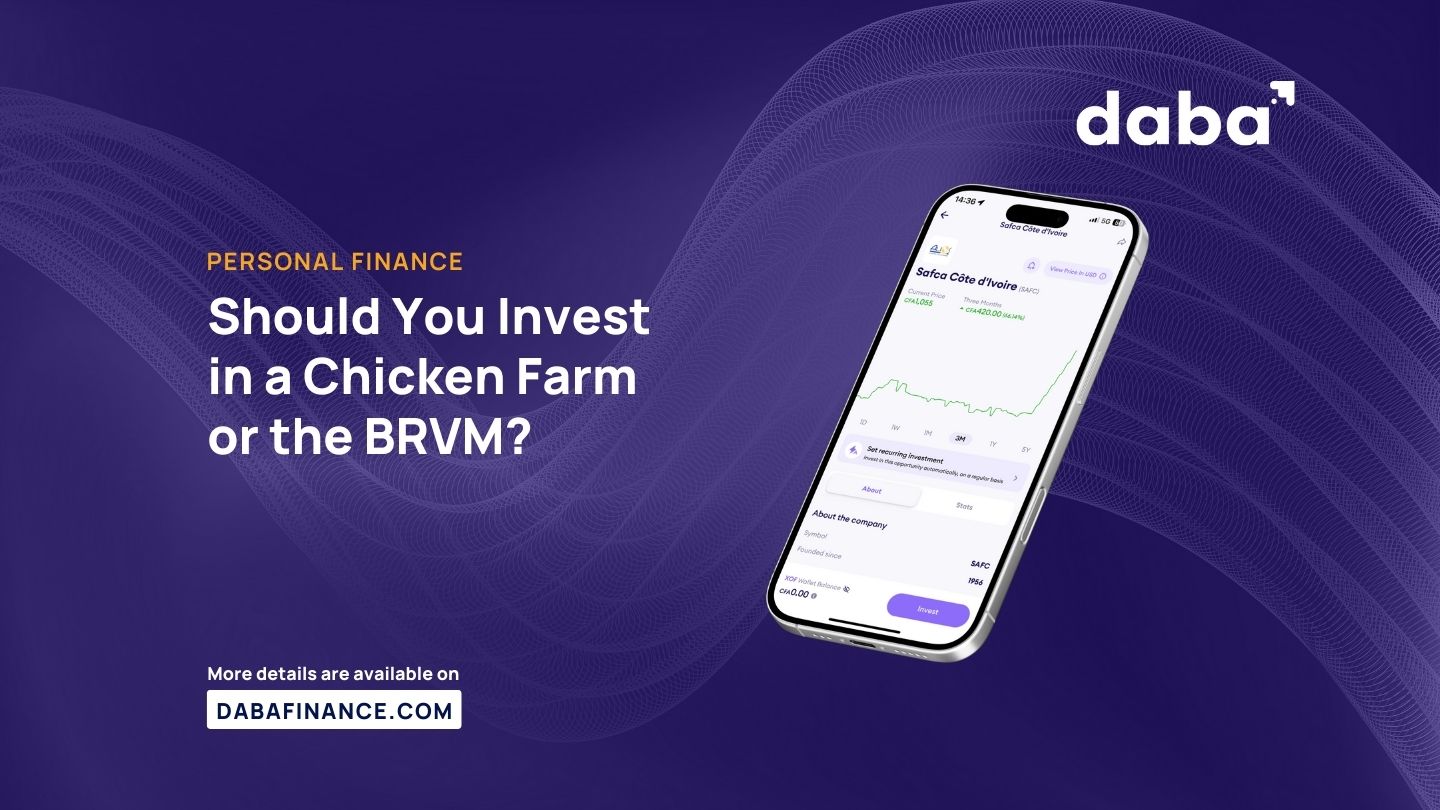
For many retail investors in Côte d’Ivoire, the question is simple: Is it smarter to invest money in a chicken farm or to put it into the BRVM?
Both options can create real wealth — but their risk profiles, capital needs, and effort required are very different. We explore both options below.
Option 1: The BRVM – Huge Upside, Low Effort
The BRVM has been one of Africa’s best-performing stock markets in 2025.
- BRVM Composite Index: +24.73% YTD (2025)
- Many individual stocks have returned 100%–400% YTD, as seen in the attached list:
- Unilever CI: +486%
- SITAB: +300%
- SILOX/CFI/SAPH also showing triple-digit gains
- Banks (BOA, BICICI, Ecobank) posting 30–70% annual returns
Why the BRVM Is Attractive Today
- High liquidity for a frontier market – thanks to digital investment platforms.
- Strong dividend culture – banks and consumer staples often yield 5–10% per year.
- CFA franc stability – pegged to EUR, reducing currency risk.
- No operational stress – no staff, no disease outbreaks, no raw material shortages.
Capital Required
You can start with as little as 10,000 XOF.
Potential Returns
- Base case (index return): 20–25% per year
- Optimistic case (stock picking): 40–100%+ per year
- Dividend income: 5–8% annually
Risks
- Market volatility
- Company-specific shocks (fraud, bad results, regulation)
- Liquidity constraints for smaller stocks
- Behavioral risks: panic selling, poor diversification
But overall, investing in the BRVM requires very low time commitment and delivers strong historical returns.
Option 2: Starting a Chicken Farm
A small farm (300–500 broilers or 200–300 layers) is a common business idea, but it is far more complex than people imagine.
Step-by-Step Breakdown: What It Takes to Launch a Chicken Farm
A. Planning & Setup
- Choose between broilers (cycle 6–8 weeks) or layers (18-month cycle).
- Find a suitable location (outside dense areas).
- Build or rent a poultry structure.
Setup Costs:
| Item | Estimated Cost (XOF) |
| Basic poultry house (500 birds) | 500,000 – 1,500,000 |
| Feeders & drinkers | 100,000 – 250,000 |
| Water system | 50,000 – 150,000 |
| Lighting & ventilation | 50,000 – 200,000 |
| Sanitization materials | 30,000 – 60,000 |
| Initial chicks (broilers) | 500–700 XOF per chick |
| Vaccines + vet care | 40–70 XOF per chick |
| First-cycle feed | 350,000 – 600,000 |
| Total initial investment | 1,300,000 – 3,000,000 XOF |
B. Operating the Farm: Weekly Work Required
- Buy feed (price volatile).
- Clean the coop daily.
- Ensure temperature & ventilation.
- Vaccinate and monitor birds.
- Manage waste disposal.
- Negotiate with buyers (restaurants, markets, wholesalers).
This is manual work, almost every day.
C. Potential Returns
Example: 500 Broiler Chickens
- Purchase price: 500–700 XOF each
- Sell price (after 6–8 weeks): 2,500–3,500 XOF per chicken
- Gross revenue: 1,250,000 – 1,750,000 XOF
- Total cost per cycle: 800,000 – 1,200,000 XOF
Net profit per cycle:
→ 450,000 – 550,000 XOF every 45 days
→ 360,000 – 450,000 XOF per month equivalent
Annual ROI Estimate
If all cycles run smoothly:
→ 30% to 60% annual return on capital
But Here Are the Real Risks
- Disease outbreaks (Newcastle, avian flu) can wipe out the flock.
- Feed price volatility (the majority of costs).
- High mortality if ventilation, vaccination, or hygiene fails.
- Market access risk — selling birds at full price is not guaranteed.
- Labour-intensive — requires daily involvement.
- Cashflow gaps — revenue comes in cycles, but costs are constant.
If one cycle fails, your annual return can drop from +40% to −20% instantly.
3. Comparing Both Options for a Retail Investor
Capital Requirement
- BRVM: Start from 10,000 XOF
- Chicken Farm: ~1.3–3.0 million XOF upfront
Operational Work
- BRVM: Almost none
- Chicken Farm: Daily manual work + vet management
Reliability of Returns
- BRVM: Volatile but historically strong
- Chicken Farm: Highly profitable but fragile and inconsistent
Liquidity
- BRVM: Immediate (sell any time with digital platforms)
- Chicken Farm: Low (birds must reach maturity to sell)
Risks
- BRVM: Price swings, company performance
- Chicken Farm: Disease, feed prices, mortality, labor risks, climate, regulations
4. So…Which Is Better?
If you want passive, scalable, liquid returns:
✔️ BRVM investing is the better choice.
You can compound capital quietly with strong long-term returns and minimal effort.
If you want an active business that can deliver higher—but unstable—profits:
✔️ A chicken farm can outperform — but only with expertise, discipline, and risk management.
It is a real business, not a side hustle.
Comparison: Chicken Farm vs. BRVM Investment
| Category | Chicken Farm (Small-Scale) | BRVM Investment |
| Minimum Capital Needed | 1,300,000 – 3,000,000 XOF | 10,000 XOF (can start smaller) |
| Typical Annual Returns | 30% – 60% (if no cycle failure) | 20% – 25% on index / 40% – 100%+ on selected stocks |
| Liquidity | Low – cash only after birds mature (6–8 weeks per cycle) | High – can sell shares anytime |
| Time & Effort Required | Very high (daily feeding, cleaning, vaccination, monitoring) | Very low (monitor portfolio, quarterly review) |
| Skill Level Needed | High – animal care, disease control, supply chain, negotiation | Low to medium – learn investing basics |
| Operational Risks | Very high: disease, mortality, feed price volatility, climate, theft, labour challenges | Medium: market volatility, poor stock selection, macro risk |
| Income Predictability | Highly variable – revenue depends on survival rate & market access | Moderate – dividends predictable, price appreciation uncertain |
| Profit Cycle | Every 45 days (broilers) or monthly (layers’ eggs) | Continuous – can realize profits any time |
| Scalability | Limited by land, labour, and disease risks | High – can scale portfolio instantly with more capital |
| Regulatory Requirements | Minimal but subject to veterinary and sanitation rules | Very low – only KYC/AML compliance |
| Sensitivity to Market Conditions | High–feed cost spikes + disease outbreak = profit collapse | Medium – depends on company earnings and overall market sentiment |
| Passive or Active? | Active business (hands-on) | Passive investment |
| Worst-Case Scenario | Full flock loss → total capital depletion | Portfolio decline → temporary or partial loss |
| Best-Case Scenario | 60%+ annual ROI if cycles run well and mortality is low | 100%–400%+ on high-performing stocks; plus dividends |
| Suitability for Beginners | Not ideal unless trained or supervised | Very suitable — beginner-friendly |
Final Verdict
For the average retail investor in Côte d’Ivoire, investing in the BRVM is a safer, easier, and more consistent way to build wealth.
A chicken farm can generate high returns, but it requires:
- high discipline,
- daily operations,
- risk tolerance for disease and mortality, and
- solid working capital.
A balanced strategy could be:
👉 Build savings and investment cash flow through BRVM investments first,
👉 then expand into a chicken farm once you have the time, capital, and experience to manage it professionally.
Leave a Reply