Tag: South Africa

  • What Are Stocks and Why Should You Invest in Them?

    What Are Stocks and Why Should You Invest in Them?

    Investing your hard-earned money can be daunting, especially with the multitude of options available in the financial market. However, one avenue that has consistently proven to be lucrative over the years is the stock market. 

    Stocks offer individuals the opportunity to become part-owners of companies and share in their profits. 

    We will explore what stocks are and why you should consider investing in them.

    What are stocks?

    Stocks, also known as shares or equities, represent ownership in a company. 

    When you buy stocks, you are essentially purchasing a small piece of that company, granting you a share of its assets and earnings.

    How stocks work

    Understanding how stocks work is vital for investors seeking to grow their wealth. 

    When an investor purchases shares of a company’s stock, they become a partial owner and gain the potential to benefit from the company’s growth and success. 

    As the company performs well, the value of its stock tends to increase, allowing investors to sell their shares at a higher price and earn a profit.

    Let’s say an investor, John, decides to purchase 100 shares of ABC Company at a price of $10 per share. John believes that ABC Company has strong growth prospects due to its innovative products and increasing market demand. 

    After a few months, ABC Company announces positive earnings results, and the market responds favorably. As a result, the stock price of ABC Company rises to $15 per share. John decides to sell his 100 shares at this higher price. By selling his shares at $15 per share, John earns a profit of $500 ($15 – $10 = $5 profit per share × 100 shares).  

    This demonstrates how investors can benefit from the appreciation in stock prices but it’s important to note that stock prices can also decline, resulting in potential losses.

    As a shareholder, you may benefit from both capital appreciation (an increase in the stock price) and dividends (a share of the company’s profits distributed to shareholders).

    Stock prices are influenced by various factors, including the company’s financial performance, market conditions, industry trends, and overall economic outlook. 

    As an investor, you have to analyze these factors to make informed decisions about buying, holding, or selling stocks, either independently or with the help of an investment advisor.

    image from Nairobi Stock Exchange

    Investors can choose between different types of stocks, such as common stocks and preferred stocks. Common stocks provide voting rights and the opportunity to receive dividends, while preferred stocks offer a fixed dividend payment but typically do not carry voting rights.

    Stocks are bought and sold on stock exchanges, such as the NYSE, NASDAQ, BRVM, NGX, JSE, etc. Investors can trade stocks through brokerage accounts, either by placing market orders (buying or selling at the prevailing market price) or limit orders (specifying a desired price range for buying or selling).

    Investing in stocks carries risks, as stock prices can fluctuate, and investors may experience losses. Diversification, thorough research, and a long-term perspective are key to managing risks and maximizing returns in the stock market. 

    Pros of investing in stocks

    1. Potential for high returns: Stocks have historically provided higher returns compared to other investment options over the long term, allowing investors to grow their wealth.
    2. Ownership in companies: Buying stocks grants investors partial ownership in companies, providing them with a stake in the company’s success, potential dividends, and voting rights.
    3. Diversification opportunities: Investing in stocks allows for diversification across different industries and sectors, reducing the risk associated with having all investments in a single asset class.
    4. Liquidity: Stocks are highly liquid investments, meaning they can be bought or sold relatively quickly, providing investors with the ability to access their funds when needed.
    5. Flexibility: Investors have the flexibility to choose from a wide range of stocks, industries, and investment strategies based on their risk tolerance, investment goals, and personal preferences.

    Cons of investing in stocks

    1. Volatility and market risk: Stock prices can be highly volatile, fluctuating in response to market conditions, economic factors, and company-specific news. This volatility can result in short-term losses and requires investors to tolerate market fluctuations.
    2. Potential for loss: Investing in stocks carries the risk of losing some or all of the invested capital, particularly if the company underperforms or faces financial difficulties.
    3. Lack of control: As minority shareholders, individual investors have limited control over the decision-making process of the company, leaving them reliant on the management’s actions and performance.
    4. Psychological impact: Stock market fluctuations and price movements can create emotional stress for investors, leading to impulsive decision-making or panic selling during market downturns.
    5. Time and expertise required: Successful stock investing requires time, research, and knowledge of financial markets. Investors need to stay informed about company performance, market trends, and economic indicators to make informed investment decisions. A lack of expertise or proper research can result in suboptimal investment choices.

    Jumia’s IPO on the NYSE

    Why should you invest in stocks? 

    While there are risks involved, investing in well-established companies or diversified portfolios can provide significant returns over time.

    Stocks can be a veritable source of extra income. Many companies distribute dividends to their shareholders, providing a regular stream of income. Dividend stocks can be an attractive option for those seeking consistent returns.

    In addition, the flexibility and liquidity that stocks offer allow you to adapt your investment strategy based on changing market conditions or personal financial goals.

    While investing in stocks can be rewarding, it’s important to conduct thorough research, diversify your portfolio, and consider your risk tolerance before diving in. It’s also advisable to seek guidance from a financial advisor who can provide personalized advice based on your financial situation and goals.

    Overall, stocks represent ownership in companies and offer individuals the potential for long-term growth, dividends, and voting rights. Investing in stocks can be a powerful tool for wealth creation, but it’s crucial to approach it with careful consideration and informed decision-making.

    Final Remarks
    For those considering an entry into the stock market or diversifying their current portfolio, remember that knowledge is your most potent weapon. Invest time in understanding market trends, diversify your holdings, and never hesitate to seek advice from seasoned professionals. Your financial journey in the stock world begins with a single step, but make sure it’s a well-informed one. If you’re curious and eager to tap into this potential goldmine, start today by researching companies, understanding market dynamics, and staying up-to-date with the latest happenings. The world of stocks awaits – are you ready to dive in?


    Disclosures: This material has been presented for informational and educational purposes only. The views expressed in the articles above are generalized and may not be appropriate for all investors. The information contained in this article should not be construed as, and may not be used in connection with, an offer to sell, or a solicitation of an offer to buy or hold, an interest in any security or investment product. There is no guarantee that past performance will recur or result in a positive outcome. Carefully consider your financial situation, including investment objective, time horizon, risk tolerance, and fees prior to making any investment decisions. No level of diversification or asset allocation can ensure profits or guarantee against losses. Articles do not reflect the views of DABA ADVISORS LLC and do not provide investment advice to Daba’s clients.

  • Why Big Tech is Building Data Centers in Africa

    Why Big Tech is Building Data Centers in Africa

    A rapidly growing digital economy in Africa is drawing investments from the world’s biggest tech companies into the continent’s data center market, which is largely untapped.


    For over a decade, Africa has been experiencing a massive boom in mobile internet adoption, outpacing other regions globally.

    This fast-growing mobile economy has enabled the emergence of several mobile-led tech solutions on the continent, such as mobile money and online shopping.

    And the startups providing these services have drawn attention, and billions of dollars in venture funding, from the world’s biggest tech companies and investors.

    In 2022 alone, African startups secured $6.5 billion in venture funding, an 8% increase from the previous year, while global VC investments declined -35%.

    But it’s not just startups and software solutions pulling investments in Africa’s digital economy.

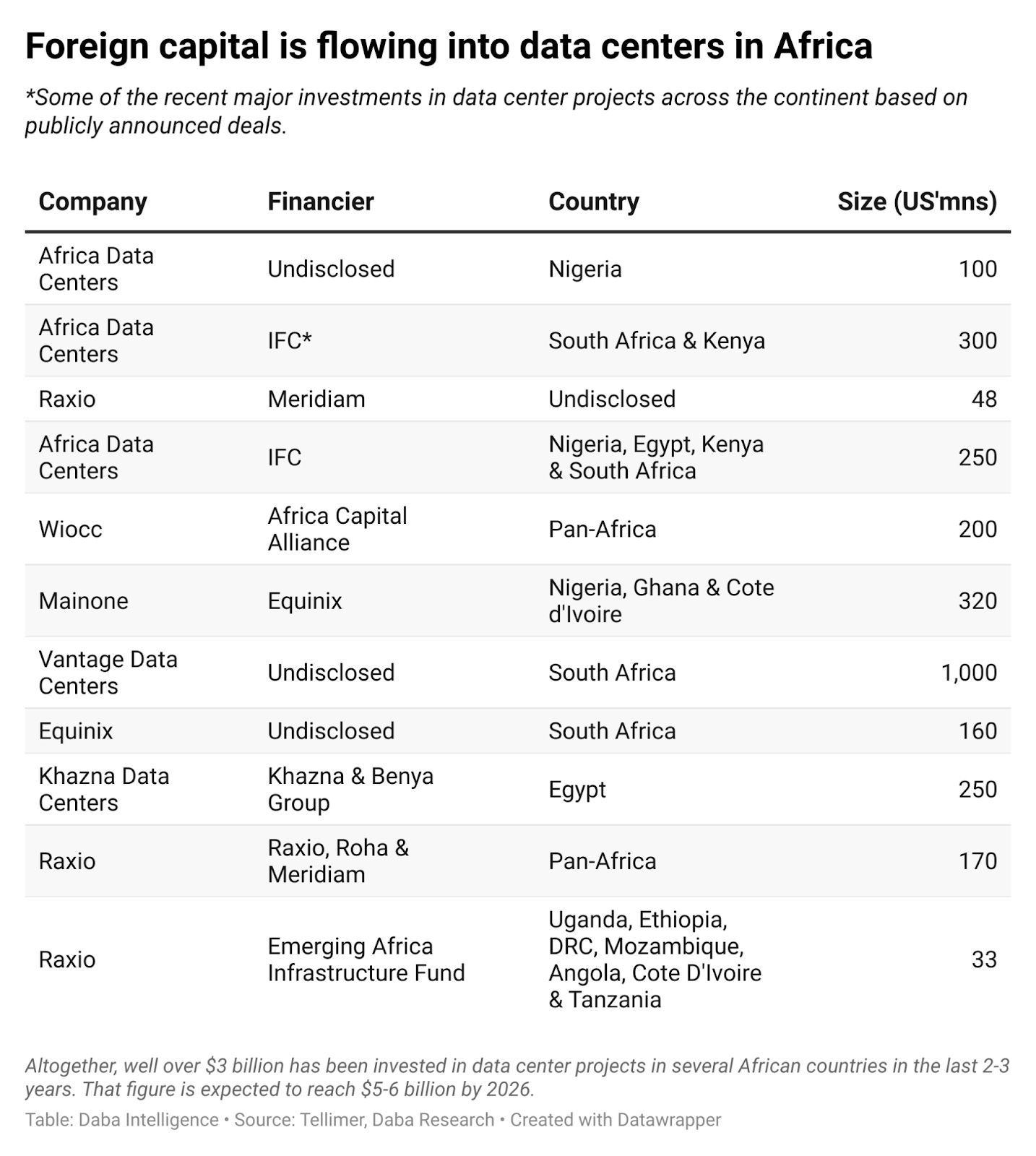
    Foreign capital has also flown into digital, hardware infrastructure, especially data centers.

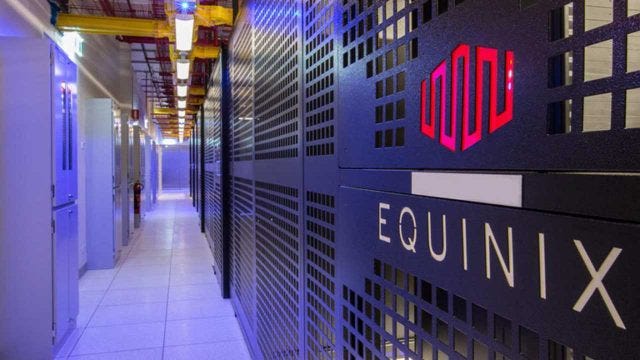
    Oracle, Microsoft, Amazon, Equinix, and Huawei are some big names building or buying data centers across Africa.

    Regional operators such as MainOne, Africa Data Centers, Raxio, Icolo.Io (Digital Realty), and IXAfrica as well as the likes of Telecom Egypt, NTT Global Data Centers, Paratus Namibia, Rack Centre, Teraco Data Environments (Digital Realty), and Wingu are also big players in the space.

    In 2022, the market also witnessed the entry of investors like Vantage Data Centers, Airtel Nigeria, Cloudoon, Open Access Data Centres, and Kasi Cloud.

    For instance, Open Access Data Centres opened more than 20 data center facilities in South Africa and Nigeria.

    Together, they’ve invested well over $4 billion in data center projects across Africa since 2021 at least.

    But, what exactly are data centers, and why are big tech players racing to build them in Africa?

    US-based Equinix acquired West African data center and connectivity solutions provider, MainOne, for $320 million in 2022. Image credit: The Guardian Nigeria

    The backbone of the digital world

    The first things that come to mind when we hear words like “online”, “digital”, “digital world” or “technology” are probably the internet, social media, mobile apps, business software, etc.

    But have you ever wondered where all the information on the internet we access through smartphones or computers is stored? 

    Well, data centers are like giant warehouses that store and protect all the data we see online.

    They’re super crucial for the internet to work smoothly and are the major enablers of online services—think digital banking, social media, streaming services, video calls, and about everything we do online.

    Just as a library stores and organizes books for easy access, data centers store and manage an immense amount of digital information. 

    And with the increasing amount of information and data to store as the digital economy continues to grow rapidly, they have become even more critical.

    How does this concern Africa?

    There’s a massive opportunity to build these data centers on the continent and make lots of money from it!

    Nairobi-based East Africa data center, a subsidiary of Liquid Telecom Kenya. Image credit: ESI Africa

    The data center opportunity in Africa

    Emerging technologies such as AI, IoT, or cloud computing are not new in Africa.

    But there has been a recent surge in the adoption of such enterprise digital solutions, especially among mid-to-large businesses across several sectors—a trend mainly induced by the Covid-19 pandemic.

    In South Africa alone, the use of cloud computing is expected to grow 25%, generating up to $1.5 billion by 2024.

    And seeing this growth, global cloud services providers such as Amazon Web Services, Microsoft, IBM, and Oracle are expanding their presence in Africa with new cloud regions being set up.

    Be it enabling consumers to buy food or clothes online or make money transfers via mobile apps, these activities generate huge volumes of data that need to be stored adequately.

    This, in turn, creates a higher demand for data centers.

    For investors, this presents a great opportunity to fill significant gaps, as most of Africa’s data is currently stored outside the continent.

    That leads to slower connections and data privacy concerns.

    Messages sent from the continent’s southern tip to Europe and back can take as long as 180 milliseconds, causing frustration for individuals trading stocks or playing video games, per The Economist.

    But significant multi-billion dollar investments in data centers are set to change this scenario. 

    These investments will significantly reduce internet latency and bring it much closer to African users, paving the way for a remarkable advancement in the continent’s digital economy.

    More so, African governments are keen to build their data centers to ensure data sovereignty and stay competitive in the increasingly AI-powered world.

    How a data center looks from the inside. Image credit: CIO

    Investments in data centers skyrocket

    As investors increasingly realize the opportunity in Africa’s data center market, the continent has seen a flurry of activities in the space over the last few years.

    This ranges from the launch of new or expansion of data centers to millions of foreign investments pouring into operators.

    Data from ReportLinker, an AI-driven market intelligence platform, indicate the sector recorded up to $2.6 billion in investments in 2021, including $200 million in debt and equity raised by WIOCC.

    Around $5.4 billion is expected to be invested in the next four to five years alone but going by investment trends last year, the continent might smash those estimates!

    In 2022, Vantage launched a $1 billion campus in Johannesburg to house three data centers.

    Khazna Data Centers is entering Egypt with a $250 million hyper-scale data center.

    And in April, Raxio Data Centres secured up to $170 million—from Proparco and the Emerging Africa Infrastructure Fund—for data center projects across multiple African countries.

    Acquisitions are also growing…

    Alongside huge capital raises, Africa’s data center market has also been seeing major investments in the form of mergers and acquisitions.

    One such example is the $320 million acquisition of West Africa operator MainOne by US-based Equinix in 2021.

    In the same year, Digital Realty bought Nigeria-based Medallion Data Centers and South Africa’s Teraco Data Environments.

    Meanwhile, African Infrastructure Investment Managers (AIIM), a private equity firm, acquired Ngoya Etix Data Centers, all for undisclosed sums.

    Most of these deals go unnoticed as digital infrastructure such as submarine cables, fiber optics, telecom towers, and data centers belong in the not-so-shiny segment of the tech ecosystem.

    But they’re crucial to the continued functioning of the digital world as most people know it. 

    Impressive figures, but not nearly enough

    Despite the investment deals and figures, Africa still needs way more data centers to match other continents than is currently being built.

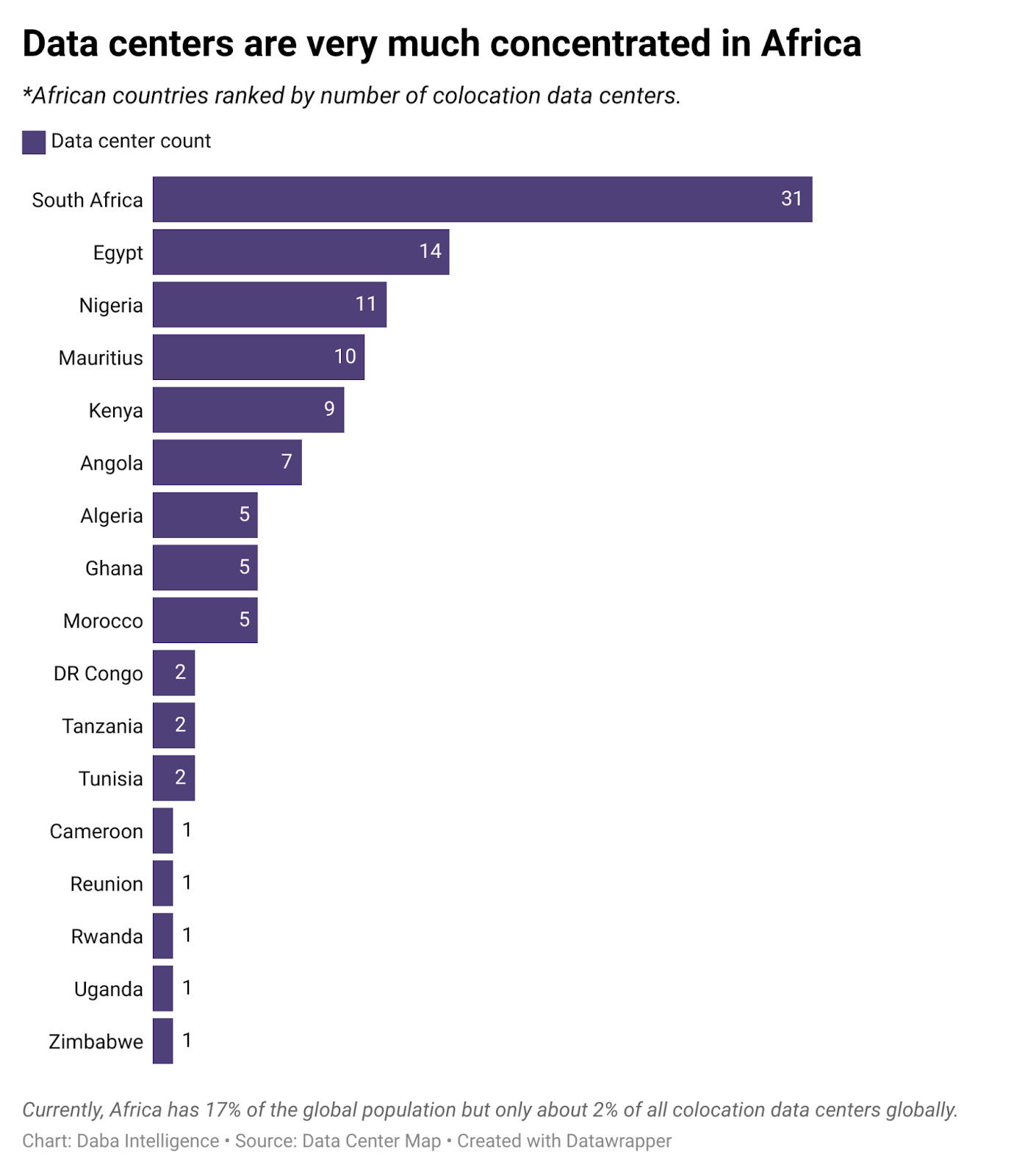
    Currently, Africa has 17% of the global population but only about 2% of all colocation data centers globally—quite a gap!

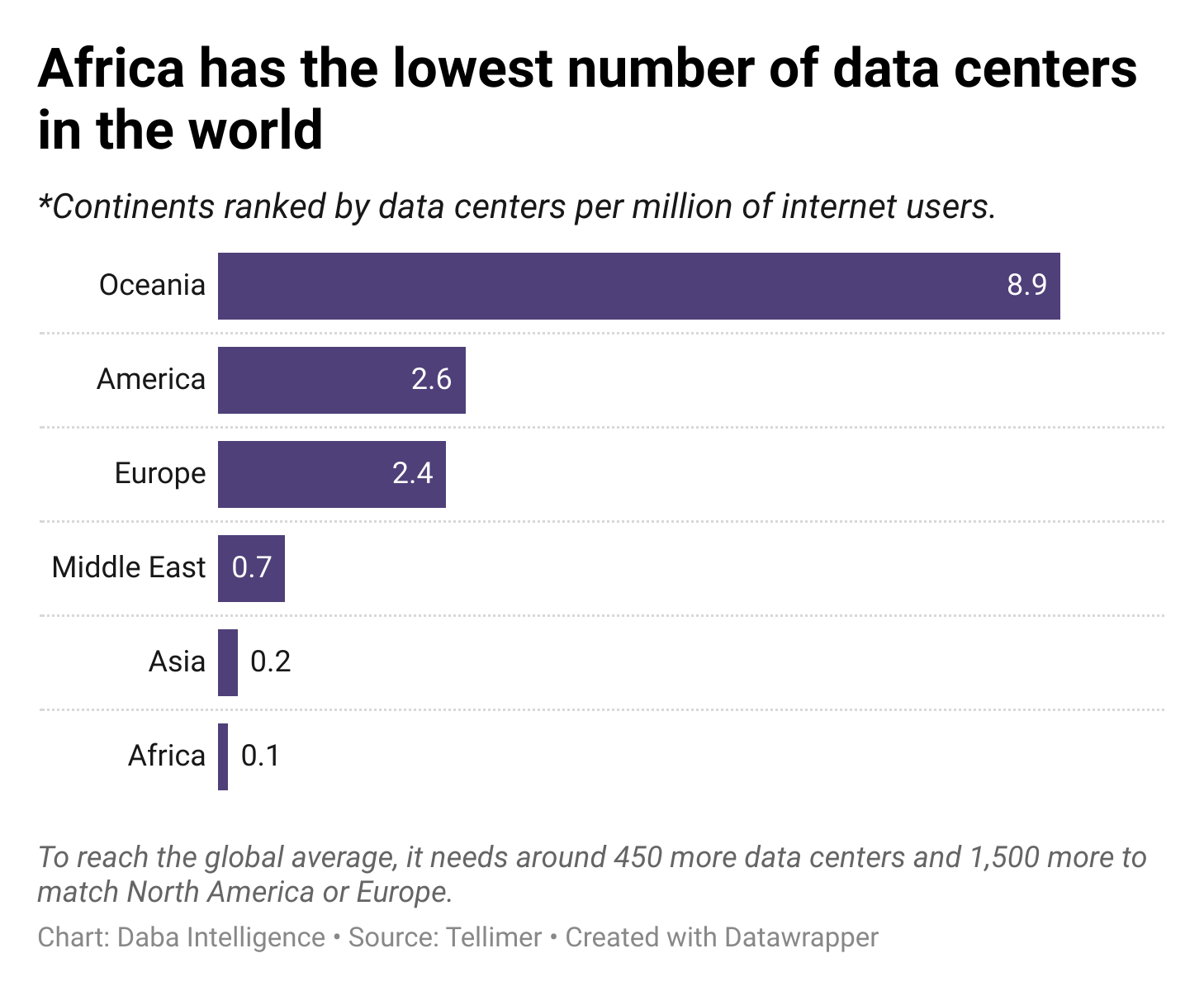
    For a better perspective, the continent has only 0.1 data centers per million internet users, far behind the global average of 0.9.

    And as of last year, it only had five more data centers than the Indian city of Mumbai alone.

    To reach the global average, Africa needs around 450 more data centers and 1,500 more to match North America or Europe.

    In addition to the growing demand for cloud-based services among businesses, more of these facilities are needed to support Africa’s growing digital population.

    The existing data centers on the continent are also very much concentrated in a few African countries. 

    For instance, Nigeria, Kenya, and South Africa together host about 60% of sub-Saharan Africa’s commercial data centers.

    The latter alone has the most data centers in the region and is expected to account for the bulk of Africa’s $5 billion data center market by 2026.

    The major data center markets will continue to attract the lion’s share of investment into the sector.

    But the good news is that smaller economies such as Ethiopia, Morocco, Algeria, Ghana, Cote d’Ivoire, Zambia, DRC, Namibia, and Rwanda are starting to attract noticeable funding.

    They’ve received up to $700 million of capital investment annually for two years now, per research firm Xalam Analytics, which closely monitors the industry.

    Big tech’s increasing investments in Africa’s data center capacity expansions indicate significant growth potential for the market. 

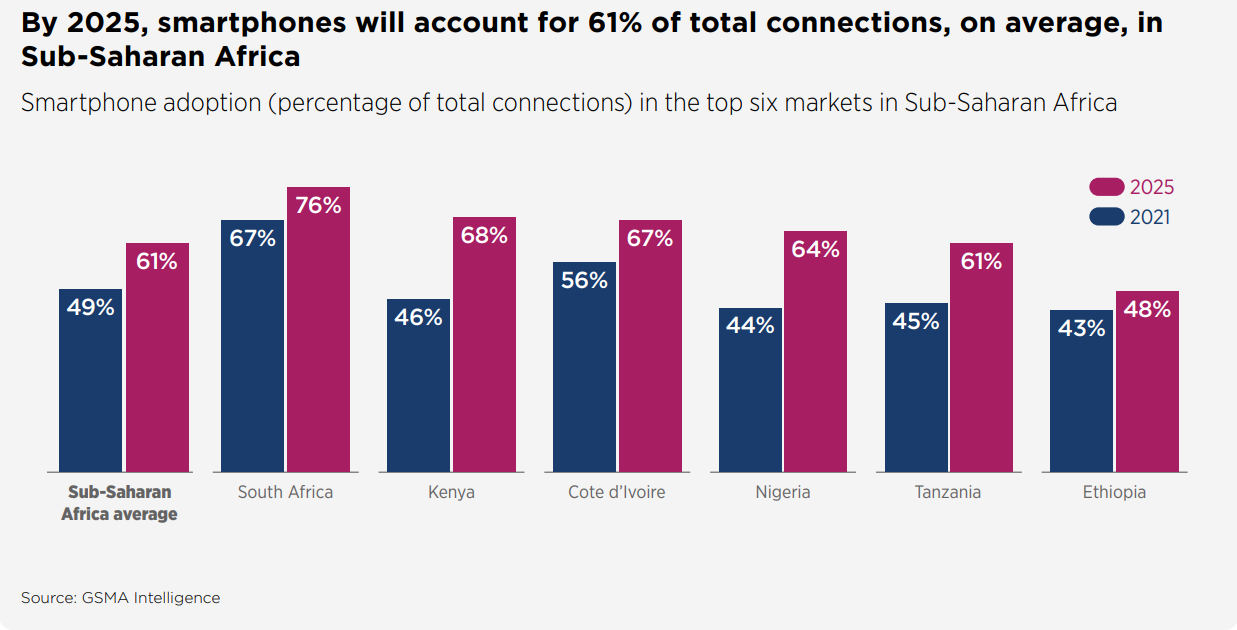
    And it comes as Africa’s digital revolution needs more capacity to support its growing smartphone and internet users, 4G expansion, and 5G rollout.

    The increasing number of data centers across the continent also creates new opportunities for telecom players.

    It’s a huge opportunity for investors that big tech companies are moving fast to capture, as the numbers show.

    An exciting future

    Amid a rapidly growing digital economy, we can expect more data center capacity expansion across various countries in Africa.

    And as large numbers of data centers along with large power capacities come up, Africa can be called—and rightly so—the next frontier of the data center industry.

  • Raisons d investir dans les marchés émergents d Afrique 🌍

    Raisons d investir dans les marchés émergents d Afrique 🌍

    Le continent africain devient rapidement l’une des nouvelles destinations les plus prometteuses pour les investisseurs des marchés émergents.


    En fait, depuis plus de 20 ans, le Forum économique mondial a identifié que plus de la moitié des économies à la croissance la plus rapide dans le monde se trouvent sur le continent. Avec des ressources naturelles abondantes, une main-d’œuvre jeune et de plus en plus éduquée, une stabilité politique relative et des perspectives indéniables de croissance économique, il n’y a aucun doute sur la vitalité pour les investisseurs.

    De bout en bout, l’Afrique fait partie des rares marchés émergents à l’échelle mondiale ; l’expression, inventée par des économistes au début des années 1980, définit l’investissement dans les pays en développement. Comme toute décision d’investissement, il y a des risques inhérents, mais voici cinq raisons pour lesquelles notre direction croit que l’Afrique mérite une chance :

    1. Potentiel de croissance 📈

    Actuellement, l’Afrique représente environ 17% de la population mondiale, mais seulement 3% du PIB mondial. Ces données attestent non seulement d’un échec historique à exploiter le potentiel de développement du continent, mais mettent également en évidence les formidables opportunités à venir. Si l’Afrique continue de maintenir et d’accélérer ses réformes structurelles, beaucoup croient que le continent peut imiter la montée rapide de la Chine au cours des 50 dernières années.

    1. Innovation 💡

    Les révolutions industrielles, qu’elles soient entraînées par la vapeur, les chaînes de montage ou les ordinateurs, ont historiquement été lentes à balayer le continent africain. Cependant, l’ère de l’Industrie 4.0, de l’énergie propre, de l’intelligence artificielle et de l’innovation numérique promet d’être différente. Contrairement aux précédentes vagues de changement industriel, avoir une part dans l’ère numérique ne nécessite pas une expertise étendue ou des investissements massifs en capital. Au lieu de cela, les innovateurs et les entrepreneurs des marchés émergents sont en position de puiser dans les flux de talents et de connaissances numériques et de les convertir en biens, services et modèles commerciaux.

    1. Valorisations plus basses 📉

    Au cours de la dernière décennie, les actions africaines n’ont pas été une success story – du moins pas par rapport à des régions similaires. Les indices MSCI US et MSCI Developed World ont augmenté respectivement de 232% et 159% au cours des dix dernières années, tandis que le MSCI South Africa et le MSCI EFM Africa ex. South Africa n’ont gagné que 33% et 23%. Cela dit, certains se demandent si les actions africaines ont été à la traîne à cause de problèmes sur le continent. La réponse courte : pas vraiment. Cependant, cela présente une opportunité unique pour les investisseurs – une plus grande part de capital dans les entreprises dans lesquelles vous choisissez d’investir.

    1. Diversification 📊

    La diversification est la pratique qui consiste à répartir les investissements afin de réduire l’exposition aux risques associés à un seul type d’actif. Cette pratique vise à réduire la volatilité de votre portefeuille d’investissement au fil du temps. Si vous attendiez patiemment une opportunité d’investir dans des actions internationales, l’Afrique se présente comme une option digne.

    1. Classe moyenne en augmentation 💼

    Selon le Forum économique mondial, d’ici 2030, plus de 40% des Africains appartiendront aux classes moyennes ou supérieures ; en conséquence, il y aura une demande accrue de biens et de services. Sans parler du fait que la consommation des ménages devrait atteindre 2,5 billions de dollars (oui, billions), plus du double de celle de 2015 qui était de 1,1 billion de dollars. Une augmentation du capital ne peut signifier que plus d’opportunités de croissance économique et de développement à travers le continent, ce qui amène de plus en plus d’investisseurs à se tourner vers l’Afrique.

    C’est là qu’intervient daba. Notre plateforme simplifiée fournit ce que nous appelons des « investisseurs de tous les jours » avec des analyses d’investissement et des ressources pour la création de richesse, afin de rendre leurs décisions d’investissement dans les marchés de capitaux privés et publics africains durables.

    Pour en savoir plus sur daba et comment rejoindre notre communauté mondiale croissante d’investisseurs, visitez dabafinance.com ou connectez-vous avec nous sur LinkedIn !